
Compare Accounting Software: A Complete Guide to Choosing the Right Tool
August 17, 2026
How To Communicate Effectively With Your Orthopedic Spine Surgeon
August 17, 2026
Interactive advisory software is changing the way advisors and clients communicate, plan, and make decisions together. Instead of relying on static reports or one-time consultations, this technology allows real-time interaction, instant calculations, and personalized recommendations based on live data.
It is widely used in financial planning, legal consulting, tax filing, healthcare guidance, and business strategy. This guide explains everything in simple words, from the basic meaning of interactive advisory software to its features, benefits, challenges, and future direction, so that both beginners and professionals can understand it clearly.
What Is Interactive Advisory Software?
At its core, interactive advisory software refers to digital tools that let advisors and clients interact dynamically instead of just reading fixed documents. It replaces traditional one-way advice with a two-way, real-time experience.
Definition in Simple Terms
In simple words, interactive advisory software is a computer program that responds instantly when a user changes an input, like income, age, or goals. It recalculates results on the spot and shows updated advice or predictions. This makes the advisory process feel like a conversation rather than a static report.
How It Differs From Traditional Advisory Tools
Traditional advisory tools usually involve printed reports, spreadsheets, or one-time meetings that do not update automatically. Interactive advisory software, on the other hand, keeps working live with the user, adjusting outputs as soon as new information is entered. This constant feedback loop is what makes it more useful for modern decision-making.
How Interactive Advisory Software Works
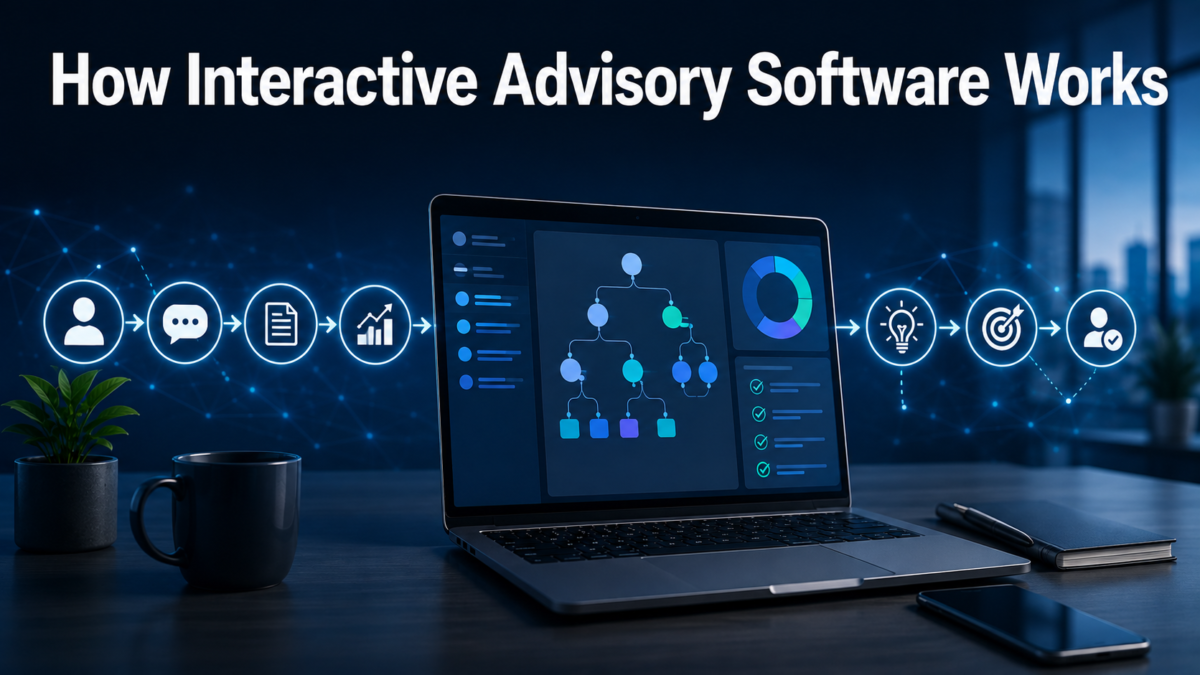
Interactive advisory software generally follows a simple flow: it collects data, processes it through built-in models, and instantly displays results. Understanding this flow helps in seeing why the software feels so responsive.
Data Collection and Client Input
The process usually begins when a client or advisor enters personal or business information into the system, such as income, expenses, goals, or risk tolerance. This information becomes the foundation for every calculation the software performs afterward.
Real-Time Scenario Modeling
Once data is entered, the software runs it through mathematical models to create different scenarios, often called “what-if” situations. Users can change one variable, like retirement age or investment amount, and instantly see how it affects the final outcome.
Dashboards and User Interface
Most interactive advisory software uses visual dashboards with charts, sliders, and graphs to present information clearly. This visual approach helps users understand complex numbers without needing deep technical or financial knowledge.
Types of Interactive Advisory Software
Interactive advisory software is not limited to one industry. It has spread across several fields where personalized, real-time guidance adds real value to decision-making.
Financial Advisory Platforms
These are the most common type, used for retirement planning, investment management, and portfolio tracking. Financial advisors use them to show clients live projections of how their savings or investments might grow under different conditions.
Legal and Tax Advisory Tools
In the legal and tax fields, interactive advisory software often takes the form of guided questionnaires. Users answer step-by-step questions, and the system generates tailored advice, documents, or tax estimates based on their specific situation.
Healthcare and Business Advisory Systems
In healthcare, such tools help patients understand treatment options or costs through interactive calculators. In business, they support management teams in testing strategies, budgets, or growth plans before committing real resources.
| Industry | Common Use | Example Feature |
| Finance | Retirement and investment planning | Live portfolio simulations |
| Legal | Document and case guidance | Interactive questionnaires |
| Tax | Tax estimation and filing help | Real-time tax calculators |
| Healthcare | Treatment and cost guidance | Symptom or cost checkers |
| Business | Strategy and budget planning | What-if business modeling |
Key Features to Look For
Not every advisory tool offers the same value, so it helps to know which features actually make interactive advisory software effective and worth using.
Personalization and Scenario Tools
Good software should adjust its advice based on individual data rather than giving generic answers. Built-in scenario tools that let users test different choices are a major sign of quality interactive advisory software.
Security and Integration
Since sensitive personal or financial data is involved, strong security measures like encryption are essential. The ability to integrate with existing systems, such as CRM or accounting software, also adds significant practical value.
Benefits of Using Interactive Advisory Software
Businesses and individuals adopt interactive advisory software mainly because it saves time and improves the quality of decisions. The benefits go beyond convenience and touch on trust, cost, and long-term planning.
Faster Decision-Making and Engagement
Because results appear instantly, users can compare options quickly instead of waiting for a follow-up meeting or report. This immediate feedback also keeps clients more engaged, since they can see the direct impact of their choices.
Cost Savings and Scalability
Automating repetitive calculations reduces the time advisors spend on manual work, lowering overall service costs. It also allows businesses to serve many more clients at once without hiring proportionally more staff.
Challenges and Limitations
Despite its advantages, interactive advisory software is not perfect, and understanding its limitations helps set realistic expectations before adoption.
Data Privacy Concerns
Since the software handles sensitive personal information, any weakness in security can expose users to serious privacy risks. Choosing providers with strong data protection policies is essential to avoid such problems.
Learning Curve and Implementation Cost
Some platforms can be complex to set up and may require training before advisors and clients feel comfortable using them. Smaller businesses may also find the initial licensing or setup cost a bit high compared to traditional methods.
Popular Market Players
Looking at existing platforms gives a clearer picture of how interactive advisory software is actually used in real business settings across different industries.
Financial Sector Names
In finance, well-known platforms include tools built for retirement and wealth planning that advisors use directly with clients during meetings. These systems are generally trusted for their detailed simulation capabilities and professional-grade reporting.
Emerging Startups
Alongside established names, many newer startups are entering the space with lighter, more affordable interactive advisory software aimed at individuals and small businesses. These newer tools often focus on simpler interfaces and mobile accessibility.
How to Choose the Right Software
Selecting interactive advisory software should not be a random decision, since the right choice depends on specific needs, budget, and the industry it will be used in.
Assess Needs and Budget
Before choosing, it is important to clearly define whether the tool is needed for personal use, a small team, or a large organization. This clarity helps in comparing pricing plans and avoiding unnecessary features.
Check Security and Reviews
Reading real user reviews and checking security certifications can reveal a lot about a platform’s reliability. Requesting a demo or trial period is also a smart way to test the software before making a final commitment.
Future Trends
The field of interactive advisory software continues to evolve quickly, driven largely by advances in artificial intelligence and changing user expectations.
AI and Predictive Analytics
Artificial intelligence is increasingly being used to predict outcomes and suggest advice automatically, rather than relying only on manual calculations. This shift is expected to make interactive advisory software more proactive rather than purely reactive.
Voice Interfaces and Big Data
Voice-based interaction and large-scale data analysis are also becoming more common in advisory platforms, allowing more natural conversations and deeper personalization. Over time, this is likely to make advisory software feel even more like a real conversation with a human expert.
Frequently Asked Questions
Is interactive advisory software safe to use?
Yes, as long as the provider uses strong encryption and follows proper data protection standards, it is generally considered safe.
Can it replace human advisors completely?
Not entirely, since human advisors still add value through experience and personal judgment that software cannot fully replicate.
How much does it typically cost?
Costs vary widely depending on features and industry, ranging from affordable individual plans to higher-priced enterprise licenses.
Is it suitable for small businesses or individuals?
Yes, many providers now offer simplified and affordable versions specifically designed for individuals and small businesses.
Conclusion
Interactive advisory software has clearly moved advisory services from static reports toward real-time, personalized interaction. It offers speed, engagement, and scalability, though it still requires attention to security and proper implementation.
As competition grows between established financial platforms and newer, more flexible startups, users are likely to benefit from better pricing and smarter features. Choosing the right interactive advisory software ultimately depends on matching its capabilities with specific personal or business needs.
Related Articles
Software Sales: The Complete Guide to Selling Software Successfully
Preventive Maintenance Software: The Complete Guide
Embrilliance Software: The Complete Guide to Embroidery Digitizing
Material Nesting Software for Length of Material: Complete Guide


