
Data Recovery Software for Corrupted SD Card: Complete Recovery Guide
August 18, 2026
MIDI Software: A Complete and Easy Guide for Beginners and Musicians
August 19, 2026
Data warehouse software is a specialized system that collects, organizes, and stores large volumes of data from multiple sources into one centralized location. It is built specifically to support reporting, analytics, and business intelligence rather than everyday transaction processing.
Companies use this type of software when they need a reliable place to combine sales records, customer information, financial data, and operational logs for deeper analysis. Unlike a regular database that focuses on quick, small transactions, data warehouse software is designed to handle massive datasets and complex queries efficiently.
This guide breaks down everything you need to know about data warehouse software in simple, easy-to-understand language, from its working process to the best tools available today.
Understanding Data Warehouse Software
Data warehouse software works as a central hub where information from different departments and systems finally comes together. Before exploring how it functions, it helps to understand why it exists and what problem it actually solves for businesses.
What Makes It Different From a Database
A traditional database is optimized for fast, small transactions such as updating a single customer record or processing an order.
Data warehouse software, on the other hand, is built to store historical data over long periods and run heavy analytical queries across millions of rows at once. This structural difference is why businesses use both systems together rather than relying on just one.
Why Businesses Rely On It
Organizations generate data from countless sources such as websites, mobile apps, point-of-sale systems, and internal tools.
Without a centralized system, this data stays scattered and difficult to analyze. Data warehouse software solves this by pulling everything into one structured environment, allowing teams to generate reports, spot trends, and make informed decisions faster than ever before.
How Data Warehouse Software Works
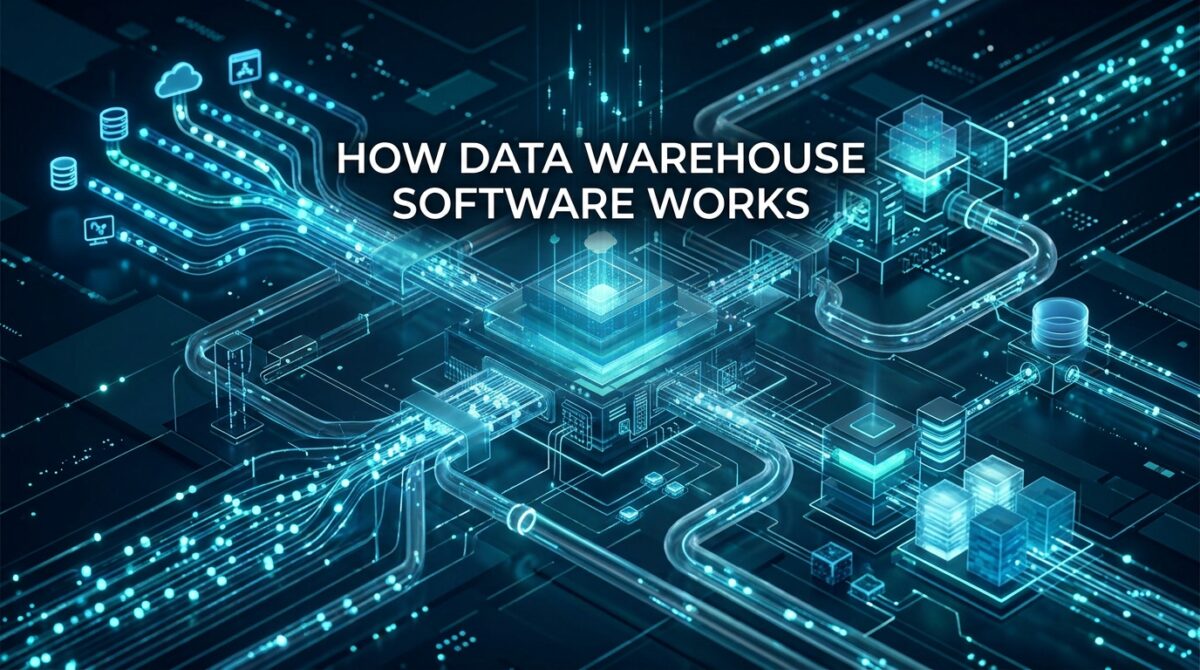
The working process of data warehouse software can be broken down into a few clear stages that move raw data from its original source into a usable, analysis-ready format. Understanding this flow makes the entire concept much easier to grasp.
Data Collection and ETL Process
The first stage involves extracting data from various source systems such as CRMs, ERPs, and external databases.
This raw data then goes through a transformation process where it is cleaned, formatted, and standardized. Finally, it is loaded into the warehouse, a sequence commonly known as ETL, which stands for Extract, Transform, and Load.
Storage and Access Layers
Once the data is loaded, it is organized into structured tables optimized for fast querying.
A presentation or access layer then sits on top of this storage, allowing business users to connect their reporting tools and dashboards directly to the warehouse. This layered approach keeps the system fast, organized, and easy to maintain over time.
Data Warehouse vs Database vs Data Lake
Many people confuse data warehouse software with regular databases or data lakes, but each of these tools serves a distinct purpose. Knowing the differences helps businesses choose the right solution for their specific needs.
Key Differences Explained
A database handles daily transactional operations, a data lake stores raw and unstructured data in its original form, and data warehouse software stores cleaned, structured data specifically for analysis and reporting. The table below summarizes these differences clearly.
| Feature | Database | Data Lake | Data Warehouse Software |
| Data Type | Structured | Raw, unstructured | Structured, processed |
| Main Use | Daily transactions | Storage of all data types | Analysis and reporting |
| Query Speed | Fast for small tasks | Slower, needs processing | Optimized for large queries |
| Users | Applications, operations teams | Data scientists, engineers | Business analysts, executives |
Types of Data Warehouse Software
Not every business has the same infrastructure needs, which is why data warehouse software is available in different deployment models. Choosing the right type depends on budget, scalability requirements, and internal technical resources.
On-Premises Solutions
On-premises data warehouse software runs on a company’s own physical servers and hardware. This option gives businesses full control over their data and infrastructure, but it also requires a larger upfront investment and dedicated IT staff for ongoing maintenance and upgrades.
Cloud-Based Solutions
Cloud data warehouse software is hosted and managed by a third-party provider, removing the need for physical hardware.
This model offers flexible pricing, automatic scaling, and faster setup, which is why most modern businesses now prefer cloud-based platforms over traditional on-premises systems.
Hybrid Solutions
Hybrid data warehouse software combines both on-premises and cloud environments, allowing sensitive data to remain in-house while less critical workloads run in the cloud. This setup is popular among organizations that need strong compliance controls alongside cloud flexibility.
Popular Data Warehouse Software in the Market
The market for data warehouse software has grown significantly, with several established players competing on speed, pricing, and scalability. Comparing these platforms side by side makes it easier to understand which one fits different business scenarios.
Snowflake and Amazon Redshift
Snowflake is known for separating storage and compute resources, which allows businesses to scale each independently and control costs more precisely. Amazon Redshift, built by AWS, is a strong choice for companies already using other Amazon Web Services products, offering tight integration and solid performance for large-scale analytics.
Google BigQuery and Azure Synapse
Google BigQuery operates on a serverless model, meaning users only pay for the queries they run rather than maintaining dedicated infrastructure. Azure Synapse Analytics combines big data processing and data warehousing in a single platform, making it a preferred option for enterprises already invested in the Microsoft ecosystem.
Other Notable Platforms
Beyond the major cloud providers, tools like Oracle Autonomous Data Warehouse, Teradata, Databricks, IBM Db2 Warehouse, and ClickHouse offer specialized strengths ranging from self-managing infrastructure to open-source flexibility. The comparison table below highlights their core focus areas.
| Software | Best For | Deployment Type |
| Snowflake | Flexible scaling, multi-cloud use | Cloud |
| Amazon Redshift | AWS-integrated businesses | Cloud |
| Google BigQuery | Pay-per-query analytics | Cloud, serverless |
| Azure Synapse | Microsoft ecosystem users | Cloud |
| Teradata | Large enterprise workloads | On-premises, cloud |
| Databricks | Combined lake and warehouse needs | Cloud |
Key Features to Look For
Selecting the right data warehouse software requires evaluating specific features that directly impact performance, cost, and long-term usability. These features often determine how well the system scales as a business grows.
Scalability and Performance
Good data warehouse software should scale smoothly as data volume increases, without requiring a complete infrastructure overhaul. Query performance should also remain consistent even when handling complex joins and aggregations across large datasets.
Security and Integration
Strong access controls, data encryption, and compliance certifications are essential for protecting sensitive business information.
Equally important is smooth integration with popular business intelligence tools such as Power BI, Tableau, and Looker, since this connectivity determines how easily teams can turn stored data into actionable reports.
Benefits and Challenges
Like any technology investment, data warehouse software brings clear advantages alongside a few practical challenges that businesses should plan for before implementation.
Business Benefits
Centralizing data leads to faster and more accurate decision-making, since teams no longer waste time searching across scattered systems. It also improves data quality, supports historical trend analysis, and gives leadership a single reliable source of truth for reporting.
Common Challenges
Implementation costs, ongoing maintenance, and the complexity of integrating multiple data sources remain common hurdles. Businesses also need skilled personnel to manage the system properly, which can be a barrier for smaller teams with limited technical resources.
Future Trends in Data Warehouse Software
The data warehouse software landscape continues to evolve rapidly as businesses demand faster insights and more automated systems. Two major trends are shaping where this technology is headed next.
AI and Automation
Artificial intelligence is increasingly being built into data warehouse software to automate tasks like query optimization, anomaly detection, and predictive analytics. This reduces the manual workload on data teams and speeds up the time it takes to generate meaningful insights.
Real-Time and Lakehouse Architecture
Many modern platforms now support real-time data ingestion, allowing businesses to analyze information as it is generated rather than waiting for scheduled updates. The rise of lakehouse architecture, which blends data lake flexibility with data warehouse structure, is also becoming a major direction for future platforms.
Frequently Asked Questions
Is data warehouse software the same as a database?
No, a database handles daily transactions while data warehouse software is built for large-scale analysis and reporting.
Which is the best data warehouse software for small businesses?
Cloud-based options like Google BigQuery or Snowflake are often preferred due to flexible, pay-as-you-go pricing.
Can data warehouse software handle real-time data?
Many modern platforms now support real-time or near real-time data ingestion alongside traditional batch processing.
Conclusion
Data warehouse software has become a core part of how modern businesses manage and analyze their data. From choosing the right deployment type to selecting a platform that fits specific performance and budget needs, understanding these fundamentals helps organizations make smarter technology decisions.
As trends like AI automation and real-time processing continue to grow, data warehouse software will keep playing an even bigger role in shaping how companies turn raw data into real business value.
Related Articles
Best Employee Engagement Software : Complete Guide
Custom Healthcare Software Development Services: A Complete Guide
Lumira Software: Complete Guide to Features, Benefits and Alternatives
Compare Accounting Software: A Complete Guide to Choosing the Right Tool


