

Intranet Software: The Complete Guide to Features, Benefits, and Best Practices
August 4, 2026
Custom Enterprise Software Development: The Complete Guide
August 4, 2026
Old 3D CGI rendering software laid the groundwork for everything we see in modern movies, games, and animations today. These early programs were built with limited computing power, yet they managed to produce groundbreaking visuals that shaped the entertainment industry.
Understanding old 3D CGI rendering software helps us appreciate how far digital art has come and why certain tools are still remembered as legends. This article explores their origins, features, challenges, and lasting impact in a simple and detailed manner. Whether you are a student, designer, or tech enthusiast, this guide will give you a complete picture of this fascinating era.
What is 3D CGI Rendering Software?
3D CGI rendering software refers to computer programs designed to convert three-dimensional models into visual images using mathematical calculations. This process, known as rendering, transforms raw geometry, textures, and lighting data into a final picture or animation frame.
Understanding the Core Function
Rendering software works by calculating how light interacts with surfaces, shapes, and materials within a virtual scene. Old 3D CGI rendering software relied on simpler algorithms compared to today’s tools, but the basic principle remained the same.
Every object in a scene was defined using coordinates, and the software calculated pixel colors based on light sources and camera angles.
Why This Technology Matters
Without rendering software, 3D modeling would remain just abstract data with no visual representation. Old 3D CGI rendering software made it possible for artists to see their digital creations come to life on screen.
This capability opened doors for filmmakers, game developers, and architects to visualize ideas before physical production began.
Why Study the History of Old Rendering Software?
Studying old 3D CGI rendering software gives valuable insight into how far technology has advanced. It also helps developers and designers understand the foundation on which modern tools are built.
Learning From the Past
Many techniques used in early rendering software, such as shading models and ray tracing basics, are still relevant today. By studying old 3D CGI rendering software, students and professionals can better understand why certain modern features exist and how they evolved over decades of experimentation.
Appreciating Technical Achievements
Given the hardware limitations of earlier decades, the achievements of old 3D CGI rendering software were remarkable. Programmers found creative solutions to work within tiny memory limits and slow processors, producing visuals that amazed audiences despite these restrictions.
Evolution of Computer Graphics: A Quick Timeline
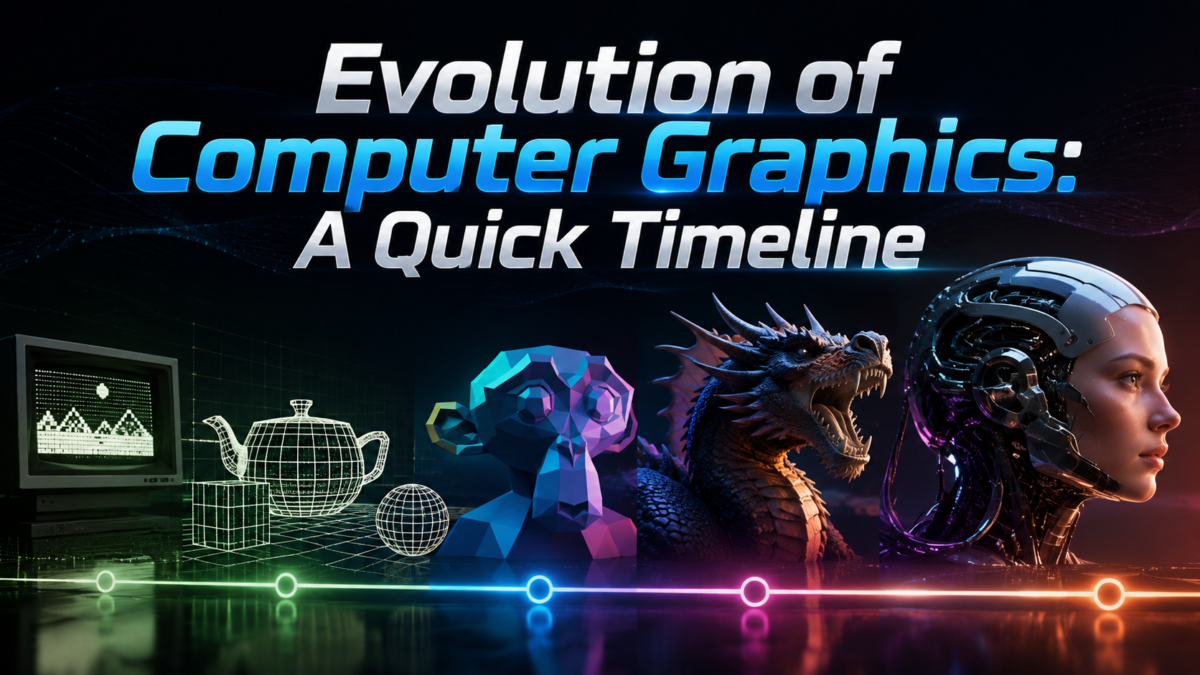
Computer graphics evolved gradually, starting from simple line drawings to fully realistic 3D scenes. This timeline helps frame how old 3D CGI rendering software developed step by step.
From Simple Lines to Complex Scenes
In the earliest days, computer graphics consisted of basic wireframe drawings without any shading or color. Over time, researchers introduced shading, texture mapping, and eventually ray tracing, which allowed old 3D CGI rendering software to produce increasingly realistic imagery.
Major Milestones Worth Noting
Several milestones shaped this journey, including the introduction of the Utah Teapot model, the first ray-traced images, and the emergence of personal computer-based 3D tools. Each milestone pushed old 3D CGI rendering software closer to what we now consider modern-quality visuals.
The Early Era of 3D Rendering (1960s–1970s)
The earliest years of 3D rendering were dominated by research institutions rather than commercial companies. This period set the theoretical foundation for all future old 3D CGI rendering software.
Origins of Computer Graphics
Computer graphics research began in university labs where scientists experimented with displaying shapes on screens using simple code. These early experiments were not commercial products but academic projects that proved 3D visualization was possible.
First Wireframe and Vector Graphics Systems
The first visual outputs were wireframe models, showing only the edges of 3D objects without any surface color. Vector graphics displays were used because they could draw clean lines efficiently, making them ideal for these early demonstrations of old 3D CGI rendering software concepts.
Key Pioneers and Research Labs
Institutions such as the University of Utah, MIT, and Bell Labs played a crucial role in developing foundational rendering algorithms. Researchers here created early shading models and geometry-handling techniques that became the backbone of future old 3D CGI rendering software.
The Rise of Commercial 3D Software (1980s)
The 1980s marked the shift from academic research to commercially available rendering tools. This decade introduced the first generation of old 3D CGI rendering software available to studios and individual artists.
Introduction of Personal Computers and Graphics Cards
As personal computers became more powerful and affordable, dedicated graphics hardware started appearing. This allowed smaller studios and hobbyists to access old 3D CGI rendering software that previously required expensive mainframe systems.
3D Studio (DOS): The Beginning of Accessible 3D
3D Studio for DOS became one of the first widely used consumer-level programs for 3D modeling and rendering. It offered modeling, animation, and rendering tools in a single package, making it a landmark example of old 3D CGI rendering software.
Wavefront Advanced Visualizer
Wavefront’s software became popular in the film and broadcast industry for its powerful rendering capabilities. It was used in several early visual effects projects, showcasing how old 3D CGI rendering software could support professional-level production work.
Alias PowerAnimator
PowerAnimator was known for its precision modeling tools combined with strong rendering output. Many industrial designers and animators relied on this software, and it later influenced the development of more advanced tools in the industry.
Early Ray Tracing Concepts
Ray tracing technology began appearing during this period, simulating how light rays travel and interact with surfaces. Though computationally expensive at the time, it represented a major leap forward for old 3D CGI rendering software in terms of realism.
The Golden Age of 3D Rendering (1990s)
The 1990s are often considered the golden age of old 3D CGI rendering software, as this decade produced several tools that became industry standards for years to come.
Lightwave 3D: Revolutionizing Broadcast and Film
Lightwave 3D gained massive popularity for its affordability and powerful rendering engine. It was used in television shows and films, proving that old 3D CGI rendering software could compete with expensive high-end systems.
Softimage 3D: Hollywood’s Secret Weapon
Softimage became a favorite among Hollywood studios for character animation and rendering. Many blockbuster films from this era relied on this software, cementing its place among the most respected old 3D CGI rendering software tools.
Autodesk 3D Studio MAX: Democratizing 3D Animation
3D Studio MAX made 3D animation and rendering accessible to a much wider audience, including hobbyists and small studios. Its user-friendly interface helped popularize old 3D CGI rendering software beyond just professional studios.
POV-Ray: Free and Open Ray Tracing Software
POV-Ray stood out as a free, script-based ray tracing program that produced highly detailed images. It remains a well-known example of old 3D CGI rendering software that thrived through community support rather than commercial marketing.
TrueSpace: All-in-One 3D Suite
TrueSpace offered modeling, animation, and rendering within a single affordable package. It attracted independent artists who wanted access to old 3D CGI rendering software without the high costs of professional studio tools.
Bryce: Landscape and Terrain Rendering
Bryce specialized in creating realistic natural landscapes, including mountains, water, and skies. This made it a unique addition to the world of old 3D CGI rendering software, focused specifically on environmental visuals.
Strata 3D: Mac-Based Rendering Solution
Strata 3D catered specifically to Macintosh users, providing solid modeling and rendering tools during a time when Mac-compatible 3D software was limited. It filled an important gap in the old 3D CGI rendering software market.
Rendering Techniques Used in Old Software
Old 3D CGI rendering software relied on several core techniques to generate images, each with different levels of realism and computational demand.
Wireframe Rendering
Wireframe rendering displayed only the outline edges of 3D objects without any surface fill. It was fast and useful for previewing models before committing to a full render.
Flat and Gouraud Shading
Flat shading applied a single color to each polygon face, while Gouraud shading blended colors smoothly across surfaces. These techniques allowed old 3D CGI rendering software to simulate basic lighting without heavy computation.
Ray Tracing Basics
Ray tracing simulated the path of light rays to calculate realistic reflections, shadows, and refractions. Although slow on older hardware, it produced some of the most impressive results seen in early rendering software.
Radiosity Rendering
Radiosity calculated how light bounced between surfaces, creating soft and realistic indirect lighting. This technique added a new level of depth to scenes produced by old 3D CGI rendering software.
Scanline Rendering
Scanline rendering processed images row by row, making it much faster than ray tracing for real-time or near-real-time previews. It became a practical solution for animators working with tight production deadlines.
Impact on Film, Games, and Animation
Old 3D CGI rendering software left a lasting mark on multiple creative industries, shaping how visual content was produced for decades.
Use in Early CGI Movies
Several pioneering films used early rendering tools to create groundbreaking visual effects that had never been seen before. These projects proved that computer-generated imagery could stand alongside traditional filmmaking techniques.
Use in Video Game Development
Game developers used old 3D CGI rendering software to create character models, environments, and cutscenes. This technology helped transition gaming from 2D sprites to fully realized three-dimensional worlds.
Influence on Visual Effects Industry
The visual effects industry grew rapidly thanks to accessible rendering tools that allowed smaller studios to compete with larger production houses. This democratization changed how visual effects work was distributed globally.
Notable Projects Created Using Old Software
Many award-winning productions from the 1980s and 1990s relied heavily on the rendering tools discussed in this article. Their success demonstrated the creative potential hidden within old 3D CGI rendering software, despite its technical limitations.
Hardware Limitations and Challenges
Working with old 3D CGI rendering software was not without difficulty, as hardware limitations created constant challenges for artists and developers.
Processing Power Constraints
Early computers had extremely limited processing power compared to modern machines, making complex renders time-consuming. Artists often had to simplify scenes just to keep rendering times manageable.
Memory and Storage Issues
Limited RAM and storage space meant that large scenes had to be carefully optimized. This forced developers of old 3D CGI rendering software to write highly efficient code to avoid crashes and slowdowns.
Render Time Challenges
A single frame could take hours or even days to render on older hardware. This made animation projects extremely time-intensive, requiring careful planning before starting any render job.
User Interface Limitations
Many early programs had complex, non-intuitive interfaces that required significant learning time. Despite this, dedicated users mastered these systems to create impressive work with old 3D CGI rendering software.
Transition to Modern Rendering Software
Over time, old 3D CGI rendering software gradually evolved into the powerful tools used by professionals today, carrying forward many foundational concepts.
How Old Software Influenced Modern Tools
Programs like Blender, Maya, and Cinema 4D borrowed core rendering concepts from earlier software. Features such as ray tracing and shading models trace their roots directly back to old 3D CGI rendering software.
Discontinued vs Evolved Software
While some old programs were discontinued entirely, others evolved into modern platforms still used today. This mix of survival and discontinuation reflects how competitive and fast-moving the rendering software industry has always been.
Legacy Features Still Used Today
Many rendering techniques from decades ago remain relevant, simply refined and optimized for modern hardware. This shows how influential old 3D CGI rendering software truly was in shaping current industry standards.
Preserving Old 3D Software
As technology moves forward, preserving old 3D CGI rendering software has become important for historical and educational purposes.
Where to Find Old Software Today
Some legacy programs are available through archives, retro-computing communities, or official company re-releases. Finding these tools allows enthusiasts to experience old 3D CGI rendering software firsthand.
Emulators and Virtual Machines for Running Legacy Programs
Emulators and virtual machines make it possible to run old operating systems and software on modern computers. This technology helps keep old 3D CGI rendering software accessible despite outdated hardware requirements.
Community and Retro-Computing Enthusiasts
Dedicated online communities continue to document, preserve, and discuss old 3D CGI rendering software. Their efforts ensure that this important part of digital history is not forgotten by future generations.
FAQs
What was the first 3D CGI rendering software?
Early research-based systems from institutions like the University of Utah are considered among the first examples, though 3D Studio for DOS was among the first commercially accessible options.
Is old 3D CGI rendering software still used today?
Some artists and retro-computing enthusiasts still use these tools for nostalgic or educational projects, though modern software has largely replaced them for professional work.
Which old rendering software influenced modern tools the most?
Softimage, Lightwave 3D, and 3D Studio MAX are widely recognized as having the strongest influence on today’s leading 3D animation and rendering platforms.
Conclusion
Old 3D CGI rendering software played an essential role in shaping the visual media we enjoy today. From simple wireframe drawings to complex ray-traced scenes, these tools represent decades of innovation and creativity.
Their legacy continues to influence modern software, reminding us how important early experimentation was for the entertainment and design industries.
Related Articles
Building Maintenance Software: The Complete Guide
Cabinet Design Software: Complete Guide for Beginners & Professionals
Real Estate Transaction Management Software: Complete Guide 2026
Cloud Based Workforce Management Software: Complete Guide 2026
Cloud Based Workforce Management Software: Complete Guide 2026


