
Perplexity Free Rank Tracking Software: Complete Guide
July 9, 2026
Fix As Glitchy Software: How to Debug Your Habits Like a Computer Program
July 9, 2026
Bank statement to excel software has become an essential tool for anyone who deals with financial records on a regular basis. It automatically pulls transaction details from PDF or scanned bank statements and arranges them neatly into an Excel sheet, removing the need for tedious manual typing.
Individuals, accountants, small business owners, and audit professionals rely on this technology to save hours every month. Instead of copying numbers line by line, users simply upload a statement and receive a clean, organized spreadsheet within seconds. This guide walks through everything you need to know about this software, from how it works to how you can choose the right one for your needs.
Introduction
Every year, businesses and individuals spend countless hours transferring bank statement data into spreadsheets for bookkeeping, tax filing, or loan processing. This manual process is slow and prone to mistakes, especially when dealing with large volumes of transactions. Bank statement to excel software solves this problem by automating the entire extraction process, turning static PDF documents into fully editable Excel files.
What is Bank Statement to Excel Software?
This type of software reads the data printed inside a bank statement, whether it is a digital PDF or a scanned image, and converts it into rows and columns inside Excel. It identifies transaction dates, descriptions, deposits, withdrawals, and running balances automatically. The final output is a spreadsheet ready for calculations, sorting, or further analysis without any retyping involved.
Why Manual Data Entry is No Longer Practical
Typing hundreds of transactions by hand takes hours and often introduces small errors that are hard to catch later. A single misplaced digit can throw off an entire financial report. As transaction volumes grow, manual entry becomes unrealistic for busy professionals, which is exactly why automated conversion tools have become so widely used.
Who Needs This Software
Accountants, small business owners, freelancers, loan officers, and auditors all benefit from this software because their work depends on accurate financial data. Anyone who regularly reviews bank records for budgeting, reconciliation, or reporting purposes finds this tool valuable for cutting down repetitive administrative work.
Understanding Bank Statements and Data Conversion
Bank statements come in different formats depending on the issuing bank, and each format presents its own challenges for extraction software. Understanding these differences helps explain why reliable conversion tools are so important.
Types of Bank Statements
Statements may arrive as digitally generated PDFs, scanned paper documents, downloadable CSV files, or exports from online banking portals. Digital PDFs are usually the easiest to process since the text is already machine-readable, while scanned documents require extra processing to recognize the printed characters accurately.
Challenges in Reading Bank Statement Data
Every bank designs its statement layout differently, using varying fonts, column arrangements, and headers. Some statements include multiple currencies or joint account details, which adds further complexity. Poor scan quality or faded print can also make it difficult for software to read certain characters correctly.
Why Excel is the Preferred Format
Excel remains the standard choice for financial data because it allows sorting, filtering, formula calculations, and easy integration with accounting systems. Once bank statement data sits inside Excel, users can quickly create summaries, track expenses, or prepare it for import into other software.
How Bank Statement to Excel Software Works
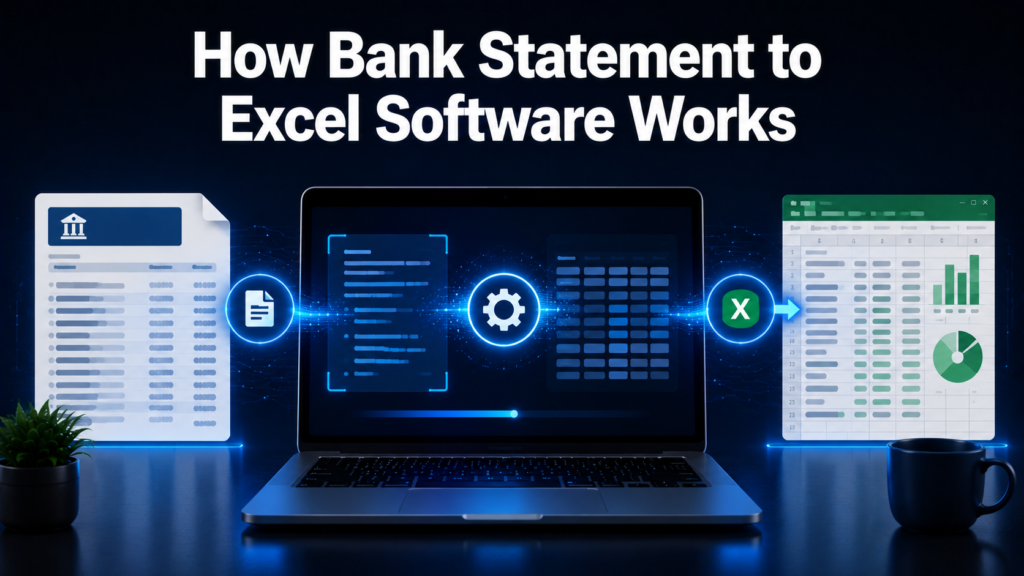
The underlying process combines document reading technology with pattern recognition to correctly separate each piece of transaction data. Modern tools rely on a mix of technical methods to achieve high accuracy across different statement styles.
Step-by-Step Conversion Process
The user typically uploads a statement file, the software scans the document structure, identifies the transaction table, and extracts each row into corresponding Excel columns. After extraction, most tools show a preview so the user can verify the data before downloading the final spreadsheet.
Role of OCR in Conversion
Optical Character Recognition, commonly known as OCR, allows the software to read text from scanned or image-based documents. It converts each character in the scanned file into digital text that can then be organized into a spreadsheet format, making it possible to process even older paper statements.
Role of AI and Machine Learning
Newer platforms use machine learning models trained on thousands of statement layouts, allowing them to recognize patterns even when a bank changes its formatting. This makes the software adaptable and reduces the need for manual template setup for every new bank.
Handling Multiple Bank Formats Automatically
Advanced tools maintain a database of known bank templates, allowing them to automatically detect which bank issued the statement and apply the correct extraction rules. This automatic detection significantly improves accuracy without requiring the user to select a format manually.
Key Features to Look For
Choosing the right bank statement to excel software depends on evaluating a handful of important features that directly affect accuracy and usability.
Accuracy and Error Free Extraction
The primary purpose of this software is precision, so the extracted numbers must match the original document exactly. High accuracy prevents costly mistakes in financial reports and saves time that would otherwise go into manual correction.
Multi Bank and Multi Currency Support
A good tool should work across statements from various banks and support multiple currencies for users dealing with international accounts. This flexibility is especially useful for businesses operating in more than one country.
Batch Processing
Batch processing allows users to upload several statements at once instead of converting them one by one. This feature is particularly helpful for accounting firms that manage many clients simultaneously.
Data Security and Privacy
Since bank statements contain sensitive financial information, the software should offer strong encryption and clear privacy policies. Some tools process data locally on the user’s device, while others use secure cloud servers, and understanding this distinction matters for security-conscious users.
Editable Output Formats
The output should support Excel, CSV, and sometimes Google Sheets, giving users flexibility depending on which platform they prefer for further analysis.
Auto Categorization of Transactions
Some advanced tools automatically label transactions into categories such as rent, utilities, or income, which speeds up budgeting and expense tracking considerably.
Types of Bank Statement to Excel Tools
The market offers a range of solutions suited to different needs and budgets, from free basic converters to fully integrated accounting platforms.
Free Online Converters
These tools are ideal for occasional users who need to convert a small number of statements without paying for a subscription, though they often come with limits on file size or monthly usage.
Paid Desktop Software
Desktop applications are installed directly on a computer and often provide higher accuracy along with offline processing, making them suitable for professionals who handle statements regularly.
AI Based SaaS Platforms
These cloud-based platforms use artificial intelligence to handle complex layouts and offer subscription plans that scale with usage, making them a strong choice for growing businesses.
Accounting Software with Built-in Conversion
Some accounting platforms include statement conversion as part of their broader toolset, allowing users to import bank data directly into their bookkeeping records without switching between applications.
Popular Bank Statement to Excel Software
Several established tools dominate this space, each with its own strengths in accuracy, pricing, and supported features.
| Software | Best For | Key Strength |
| DocuClipper | Accountants and bookkeepers | High accuracy on multiple bank formats |
| ProperSoft Bank2Excel | Individuals and small businesses | Simple, affordable desktop tool |
| Nanonets | Businesses needing automation | AI-driven extraction at scale |
| WonderFrame | Batch processing needs | Fast bulk conversion |
| PDFTables | Occasional users | Straightforward online conversion |
| Tabula | Developers and technical users | Free, open-source flexibility |
Comparing these options based on pricing, accuracy, and ease of use helps users select the tool that best matches their specific workload and budget.
Benefits of Using This Software
Adopting bank statement to excel software brings measurable improvements to how individuals and businesses manage financial data on a daily basis.
Time Saving Compared to Manual Entry
Automated conversion reduces a task that could take hours into a process completed within minutes, freeing up time for more valuable work.
Reduced Human Errors
Since the software reads data directly from the source document, it eliminates the typing mistakes that commonly occur during manual entry.
Easier Reconciliation and Auditing
Having transaction data already organized in Excel makes it much simpler to match records during reconciliation or prepare files for an audit review.
Better Financial Analysis and Reporting
Once data sits in spreadsheet format, users can apply formulas, create charts, and generate summaries that support better financial decision-making.
Useful for Loans, Tax Filing, and Bookkeeping
Lenders, tax preparers, and bookkeepers often require structured statement data, and this software delivers exactly that format without extra formatting work.
Step-by-Step Guide to Converting a Bank Statement
Understanding the general workflow helps users get accurate results regardless of which tool they choose.
- Uploading the Statement
- The process begins by uploading the PDF or scanned statement file into the chosen software platform through a simple drag-and-drop or file selection interface.
- Selecting the Bank Format
- Some tools require selecting the issuing bank manually, while others detect it automatically, which speeds up the overall conversion process considerably.
- Reviewing Extracted Data
- Before finalizing the file, users should check the preview screen to confirm that dates, amounts, and descriptions have been captured correctly.
- Exporting to Excel or CSV
- Once verified, the data can be exported directly into Excel or CSV format, ready for immediate use in reports or accounting software.
- Verifying Accuracy Before Use
- A final manual check against the original statement ensures there are no extraction errors before the data is used for important financial decisions.
Common Challenges and How to Overcome Them
Even reliable software can face obstacles depending on the quality and format of the original document.
Poor Scan Quality Issues
Blurry or low-resolution scans can confuse OCR systems, so using higher quality scans or original digital PDFs whenever possible improves extraction accuracy.
Different Statement Layouts
Since banks format statements differently, software that supports a wide template library reduces the chances of misaligned data columns.
Password Protected PDFs
Some statements are encrypted for security, requiring users to remove the password before uploading, which most tools clearly explain in their instructions.
Data Privacy Concerns
Users worried about confidentiality should choose tools with transparent security policies and, where possible, opt for local processing over cloud uploads.
Security and Privacy Considerations
Because bank statements contain sensitive personal and financial details, security should always be a top priority when selecting software.
Is It Safe to Upload Statements Online
Reputable platforms use encrypted connections and do not store files longer than necessary, but users should always review a provider’s privacy policy before uploading sensitive documents.
Local versus Cloud Based Tools
Local software keeps data entirely on the user’s device, offering maximum privacy, while cloud tools provide convenience and accessibility from any location with an internet connection.
Encryption Standards to Look For
Look for tools that mention industry-standard encryption protocols and clear data deletion policies, as these details indicate a provider takes user privacy seriously.
Use Cases by Industry
Different industries apply this software in ways that match their specific financial workflows.
Personal Finance Management
Individuals use it to track spending habits and prepare personal budgets without manually logging every transaction.
Small Business Bookkeeping
Small business owners rely on it to keep accurate records for monthly bookkeeping without hiring extra administrative help.
Accounting and Audit Firms
Professional firms use batch processing features to handle statements for multiple clients efficiently during audit season.
Loan and Mortgage Processing
Lenders use converted statements to quickly assess an applicant’s financial history during loan approval processes.
Tax Preparation Services
Tax professionals use organized spreadsheet data to speed up filing season, especially when clients submit large volumes of statements.
Free versus Paid Software
Deciding between free and paid options depends on how frequently the software will be used and how critical accuracy is for the task.
Limitations of Free Tools
Free converters often restrict file size, monthly usage, or the number of supported bank formats, which can be limiting for regular users.
When to Invest in Paid Software
Paid software becomes worthwhile once conversion needs grow beyond occasional use, especially for professionals handling client data regularly.
Return on Investment for Businesses
The time saved through automation often outweighs the subscription cost, making paid tools a practical investment for growing businesses.
Tips for Choosing the Right Software
Selecting the right tool involves comparing a few practical factors before committing to a purchase or subscription.
Checklist Before Subscribing
Consider accuracy rates, supported banks, pricing tiers, and available customer support before making a final decision.
Trial Versions and Demos
Testing a free trial with an actual bank statement helps confirm whether the software meets accuracy expectations before paying for a full plan.
Customer Support and Reviews
Checking user reviews and available support channels gives insight into how reliable the software is when issues arise.
Future of Bank Statement Conversion Technology
The technology behind bank statement to excel software continues to evolve alongside broader advancements in automation and financial technology.
AI and Automation Trends
Artificial intelligence continues to improve extraction accuracy, allowing software to handle increasingly complex and varied statement designs.
Integration with Accounting Software
More tools are building direct integrations with popular accounting platforms, reducing the need for manual file transfers between systems.
Real Time Bank Feed Alternatives
Some newer solutions are moving toward direct bank feed connections, which may eventually reduce reliance on statement conversion altogether for certain use cases.
Conclusion
Bank statement to excel software has transformed how individuals and businesses manage financial documentation by removing manual data entry from the equation. From accountants handling multiple clients to individuals tracking personal expenses, this technology offers a faster, more accurate way to organize financial records. Choosing the right tool depends on evaluating accuracy, security, pricing, and specific business needs before making a final decision.
FAQs
Is it safe to convert bank statements online?
Reputable tools use encryption and clear privacy policies, but users handling sensitive data may prefer local software for added security.
Can this software handle scanned PDFs?
Yes, most modern tools include OCR technology specifically designed to read scanned or image-based statements accurately.
Does it work for all banks worldwide?
Coverage varies by provider, so it is important to confirm that a tool supports your specific bank before purchasing a subscription.
Is there a free tool with good accuracy?
Some free converters offer decent accuracy for basic statements, though paid tools generally perform better with complex or high-volume documents.
Can I automate this process monthly?
Many paid platforms support recurring or batch processing, making monthly automation possible for regular users.
Related Articles
Standard Assessment Procedure Software Explained: A Complete Guide for Builders and Assessors
Zotac RTX 3090 Trinity OC Download Software – Complete Guide
VBox Software: A Complete Guide for Beginners and Professionals
Pros and Cons of a Parking Management Software: Complete Guide 2026
Workforce Housing Management Software Features: Complete 2026 Guide


