
Manufacturing Costing Software: The Complete Guide
July 13, 2026
Oil and Gas Data Management Software: The Complete Guide
July 13, 2026
Should cost software is a tool that helps companies understand what a product or part should actually cost to manufacture. This tool looks at factors like material cost, labor rate, machine time, and overhead to give a fair price estimate.
Its main purpose is to give procurement teams the power to verify the quote given by a supplier. When companies have their own cost estimate, they become more confident in negotiations. This guide will explain every aspect of should cost software in simple words. In the sections below, we will discuss its features, benefits, tools, and implementation process in detail.
What is Should Cost Software?
Should cost software is basically an analytical tool that calculates the “correct” cost of a product or component, rather than what the supplier is asking for. It shows the difference between the actual quoted price and the estimated fair price, which procurement teams use for negotiation.
The Difference Between Should Cost and Quoted Cost
Quoted cost is the price that the supplier gives to the company, whereas should cost is an independent estimate built from raw data. If there is a large difference between the two prices, it’s a sign that negotiation is possible. This comparison helps companies avoid unnecessary spending.
Why This Concept Matters Today
Competition today is so intense that companies have to justify every cost. The should cost approach is a data-driven method where decisions are based on facts rather than emotions or guesswork. This is especially important in manufacturing and sourcing industries.
Core Concepts Behind Should Cost Modeling
In this section, we’ll look at how should cost modeling works and the logic behind it. This concept seems simple but has quite a few technical layers within it.
Cost Breakdown Structure Explained
A cost breakdown structure is a framework in which total cost is divided into smaller parts such as material, labor, tooling, and overhead. Each part is calculated separately, and then the total cost is derived. This approach increases transparency and reveals where the most spending is happening.
Design to Cost vs Should Cost
Design to cost is a proactive approach in which cost is kept in mind while designing the product. Should cost comes afterward, once the product has already been built, to verify its fair price. Both approaches complement each other but are applied at different times.
Total Cost of Ownership Connection
Total cost of ownership doesn’t just look at the purchase price — it also includes maintenance, transportation, and lifecycle cost. Should cost software sometimes becomes part of this bigger picture so that companies can make long-term decisions on a solid foundation too. This connection is especially important in capital equipment sourcing.
How Should Cost Software Actually Works
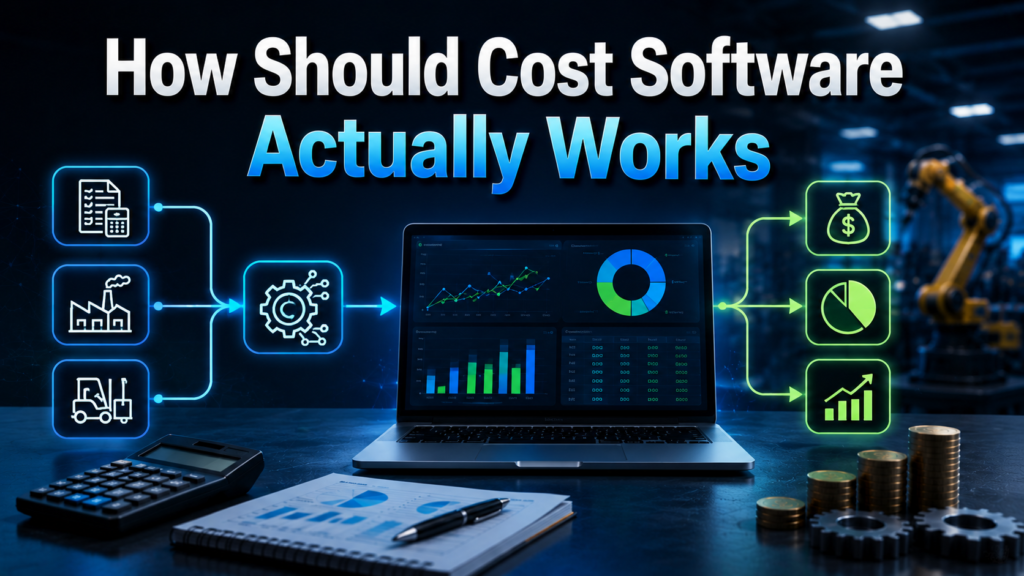
Understanding how this software works is important so you can recognize its real value. Below, its working process is broken down into steps.
Data Inputs Required for Accurate Estimates
For the software to give correct results, it needs material prices, labor rates, machine speeds, and overhead percentages. This data is taken from regional databases that are updated according to each country. The more accurate the data, the more reliable the estimate will be.
CAD Integration and Feature Recognition
Modern tools can read CAD files directly and guess the manufacturing process from the shape of the part itself. This reduces the need for manual data entry and gives the estimate quickly. This feature especially saves time for complex mechanical parts.
Process Routing and Manufacturing Simulation
The software also simulates which manufacturing steps are needed to make the part, such as cutting, molding, or assembly. Each step has its own time and cost, which is added to the total estimate. This simulation is close to real factory conditions.
Key Features Every Should Cost Software Should Have
Every tool has its own specialty, but there are some features that every good should cost software should have. These features are explained in detail below.
CAD and Material Database Integration
A good tool should be able to easily import CAD files and update material prices in real time. This integration reduces manual errors and increases the speed of estimation. Companies prioritize this feature when selecting a tool.
Scenario Modeling and What If Analysis
This feature lets the user test different scenarios, such as how the cost would change if the material changes or the quantity increases. This flexibility makes decision-making easier. Teams can compare different options and select the best choice.
Supplier Negotiation Dashboards
Some tools have special dashboards that show should cost and quoted cost side by side. This visual comparison is very useful in negotiation meetings. When data is clearly visible, trust also increases between both parties.
Benefits of Using Should Cost Software
Using this tool has many benefits, ranging from direct financial savings to better supplier relationships. These benefits are explained below from different angles.
Direct Cost Savings and Negotiation Power
When you have an independent cost estimate, you can talk to the supplier with confidence. This negotiation leverage can save companies lakhs of rupees, especially in bulk purchasing. This is the biggest and most direct benefit.
Faster and Smarter Sourcing Decisions
With should cost software, the sourcing team can quickly decide which supplier is offering a fair price. The time that manual calculations used to take is now completed in minutes. This also speeds up the overall procurement cycle.
Stronger Supplier Relationships Through Data
When negotiation is based on data rather than assumptions, the supplier also considers the process fair. This helps build long-term relationships because there is transparency on both sides. As trust increases, future deals also become easier.
Common Challenges in Should Cost Software Adoption
Like any tool, this one also has some challenges that companies should understand before implementation. These challenges are explained in detail below.
Data Accuracy and Maintenance Issues
If the cost database is old or incorrect, the estimate will also be wrong. Companies have to regularly update their data, which is an ongoing responsibility. This challenge is felt more strongly especially in volatile markets.
Learning Curve for New Teams
These tools can be somewhat complex for new users because they require both technical and engineering knowledge. Training is necessary so the team can take full advantage of the software. This process requires both time and resources.
Leading Should Cost Software Tools in the Market
There are many tools available in the market that meet the needs of different industries. Below is a comparison of some popular tools.
aPriori and Its Strengths
aPriori is an advanced tool that is strong in CAD integration and automated cost modeling. It is especially popular in the automotive and aerospace industries. Its real-time analysis capability sets it apart from competitors.
DFMA by Boothroyd Dewhurst
The DFMA tool focuses on design for manufacturing and assembly. It looks for cost reduction opportunities at the early stage of product design. Engineering teams use this tool for design optimization.
Below is a comparison table that explains these tools in a simple way.
| Tool Name | Best For | Key Strength |
|---|---|---|
| aPriori | Automotive and Aerospace | CAD-based automated costing |
| DFMA | Product Design Teams | Design optimization insights |
| Costimator | Small to Mid-size Manufacturers | Quick estimating for machining |
| Fitfactory | Manufacturing Operations | Real-time cost tracking |
| SAP Should Cost Module | Large Enterprises | ERP integration |
Industry Applications of Should Cost Software
Different industries use this tool according to their unique needs. Below are some major industries mentioned.
Automotive Manufacturing Use Case
The automotive industry sources thousands of parts, and verifying their cost manually is difficult. Should cost software automates this process and gets companies better deals. This industry is the biggest user of this tool.
Aerospace and Defense Applications
In the aerospace sector, both precision and cost are important. Should cost software helps determine fair pricing for complex components where traditional estimating is difficult. This sector depends more on accurate data due to strict compliance requirements.
Step by Step Implementation Guide
Companies should follow a structured approach while implementing this tool so the process stays smooth.
Assessing Organizational Readiness
First, the company has to check whether it has the required data and team skills or not. This assessment increases the success rate of implementation. Implementing the tool without a readiness check can be risky.
Training and Change Management
Proper training sessions are necessary to make the team comfortable with the new tool. Change management is also important so employees don’t resist the new process. Both these steps are critical for successful adoption.
Future Trends in Should Cost Software
Technology is evolving rapidly, and should cost software is also being influenced by this trend.
Artificial Intelligence in Cost Prediction
AI is now making cost prediction more accurate because it learns patterns from historical data. In the future, these tools will be able to detect cost anomalies on their own. This trend will make the procurement industry even more efficient.
Cloud Based Platforms Growth
Cloud-based should cost tools give companies flexibility because they can be accessed from anywhere. This trend is especially beneficial for global teams. Implementation has also become easier because of the SaaS model.
How Should Cost Software Compares to Traditional Methods
Traditional cost estimating mostly depended on Excel sheets and manual calculations, which were time-consuming and error-prone. Should cost software fills this gap with automation and real-time data. Competitors like generic ERP costing modules don’t offer the same depth as dedicated should cost tools, because they aren’t specifically designed for manufacturing cost modeling.
Frequently Asked Questions
Is should cost software only for big companies? No, small and mid-size companies can also use affordable tools that fit their budget.
Is the should cost estimate always accurate? The accuracy of the estimate depends on data quality, so it is always an approximate guide, not an exact number.
How long does implementation take? This depends on the company’s size and complexity, but generally it can take anywhere from a few weeks to a few months.
Conclusion
Should cost software gives procurement teams the power to understand fair pricing and negotiate better. This tool makes data-driven decisions possible, which are more reliable than traditional guesswork. By selecting the right tool and properly training the team, companies can achieve significant cost savings.
Related Articles
Oura Senior Software Engineer Interview Questions: A Complete Preparation Guide
Software Audio Console: Complete Guide to Digital Mixing
VoIP Software Skype: A Complete and Simple Guide
Axialys Pricing Call Center Software France: Complete Cost Guide
Credit Management Software: A Complete Guide for Businesses


