
Recovery Home Management Software Solutions: Complete Guide (2026)
June 24, 2026
Why Use Uhoebeans Software in Business? 7 Proven Benefits (2026 Guide)
June 29, 2026
Every business that relies on phone calls to reach customers eventually runs into the same problem: there are only so many hours in a day, and dialing numbers by hand wastes a huge chunk of them. This is where outbound dialing software steps in, turning a slow, repetitive task into a fast, measurable process that lets agents focus on conversations instead of manual dialing.
More companies across sales, support, healthcare, and collections are adopting this technology because the outbound dialing software benefits go far beyond time savings. From productivity to legal compliance, the right dialing system touches nearly every part of an outbound calling operation.
What is Outbound Dialing Software? (Basics Explained)
In simple words, outbound dialing software is a program that automatically places phone calls on behalf of agents instead of requiring them to punch in numbers one by one. It pulls contacts from a list, dials them in sequence, and connects the call to an agent the moment someone picks up, filtering out unanswered calls, busy signals, and voicemail automatically.
This is a major shift from traditional cold calling, where an agent looks up a number, dials manually, and often ends up speaking to no one. A human dialing manually might complete twenty to thirty calls an hour, while an automated system can attempt hundreds in that same hour, handing agents only the calls actually worth their time.
Types of Outbound Dialers
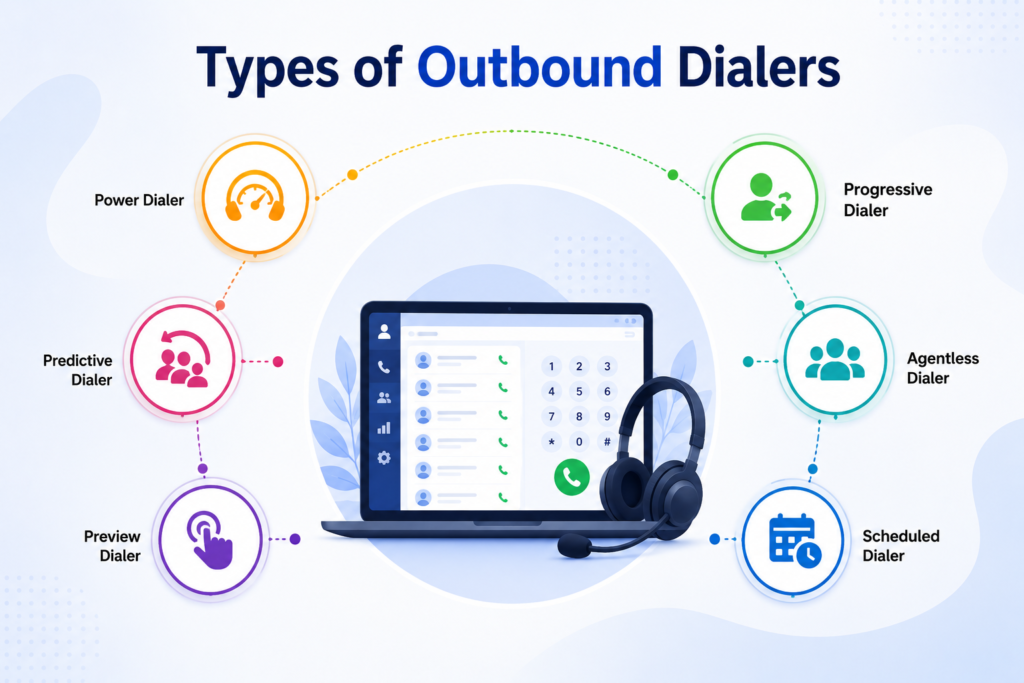
Not all outbound dialing software works the same way, and the right type depends on the nature of the calling campaign. Below is a quick breakdown of the most common dialer types and how each one behaves.
Preview Dialer
A preview dialer shows the agent details about the next contact before the call is placed, giving them a moment to review notes or account history. This suits calls where personalization matters more than speed.
Progressive Dialer
A progressive dialer automatically places the next call as soon as an agent becomes free, without letting them skip or delay it. This keeps the pace steady for teams that want consistent call flow.
Power Dialer
A power dialer calls multiple numbers at once for each available agent, increasing the chances that at least one call connects quickly. It balances speed and control for teams pushing higher volume.
Predictive Dialer
A predictive dialer uses statistical algorithms to estimate how many numbers to dial simultaneously based on agent availability and answer rates. It works best for large-scale telemarketing or collections.
| Dialer Type | Best For | Speed vs Control |
| Preview Dialer | High-value, personalized calls | Low speed, high control |
| Progressive Dialer | Steady, predictable call flow | Moderate speed, moderate control |
| Power Dialer | Higher volume with oversight | High speed, moderate control |
| Predictive Dialer | Large-scale telemarketing, collections | Highest speed, lowest control |
Top Benefits of Outbound Dialing Software
This section forms the heart of the discussion around outbound dialing software benefits, breaking down exactly how each advantage plays out in a real working environment.
Increased Call Volume and Efficiency
One of the most noticeable outbound dialing software benefits is the sheer increase in calls a team can complete in a single shift. Because the system moves automatically from one number to the next, agents stop being the bottleneck in the process.
Reduced Agent Idle Time
Idle time is one of the biggest hidden costs in any call center. Manual dialing forces agents to look up numbers and sit through unanswered rings, while outbound dialing software connects agents only when a call is live and ready.
Improved Lead Management
Most modern platforms integrate directly with a CRM, keeping contact records, call notes, and follow-up reminders connected in one place. Smart lead prioritization pushes high-value leads to the top of the queue.
Better Call Analytics and Reporting
Tracking outcomes manually across a large team is nearly impossible to do accurately, which is why analytics dashboards matter. Every call gets logged automatically, giving managers a clear picture without needing to chase updates.
Compliance and Legal Safety
Calling regulations exist to protect consumers, and ignoring them can lead to serious penalties. Outbound dialing software typically scrubs every number against do-not-call lists automatically and supports rules such as the Telephone Consumer Protection Act, removing human error from the compliance process.
Higher Agent Productivity
When agents only connect to live, answered calls instead of sitting through endless ringing, their output naturally improves. This filtering effect also reduces burnout over time, since the frustration of constantly dialing dead numbers is removed from the daily routine.
Cost Savings for the Business
Automation lowers the cost per successful call because fewer staff hours go to activity that generates no results. A business can often handle the same volume with a smaller team, and lower turnover from a less frustrating job adds further savings.
Improved Customer Experience
Shorter hold times and fewer dropped calls create a smoother first impression for the person on the receiving end. Local presence dialing, which shows a number matching the recipient’s area code, also improves answer rates since local numbers feel less like telemarketing.
Real-Time Call Monitoring and Coaching
Supervisors typically get live monitoring tools to listen in on calls without either party noticing, which helps with quality control. Many platforms also offer whisper and barge features, letting a supervisor guide or join a call directly, making new-agent training far easier.
Scalability for Growing Businesses
As a business grows or hits seasonal spikes, outbound dialing software makes it easy to scale agents or lines up or down without rebuilding infrastructure. This flexibility is especially valuable for retailers during holidays or campaigns leading up to an election.
Industries That Benefit Most
Almost any business that relies on phone outreach can gain something from this technology, but certain industries see particularly strong results because calling sits at the center of their daily operations.
• Call centers handling high volumes of both inbound and outbound customer interactions on a daily basis.
• Sales and telemarketing teams that depend on reaching large numbers of prospects to generate qualified leads.
• Debt collection agencies that need to contact large lists of accounts while staying within strict legal boundaries.
• Healthcare providers sending appointment reminders and reducing missed visits through automated outreach.
• Political campaigns and survey organizations that need to reach large populations within a limited time window.
Key Features to Look for in Outbound Dialing Software
Choosing the right platform becomes much easier once a business knows which features actually matter for its use case. The following tend to separate a genuinely useful dialing system from one that looks good on paper but falls short in daily use.
• CRM integration that keeps contact history, notes, and follow-ups synced automatically across systems.
• Voicemail drop functionality that delivers a pre-recorded message without requiring an agent to wait through the greeting.
• Call scripting tools that guide agents through consistent talking points while still allowing natural conversation.
• An analytics dashboard that presents clear, actionable performance data without requiring manual report building.
• Security and data encryption that protects both customer information and call recordings from unauthorized access.
Common Challenges and How Software Solves Them
Every calling operation faces recurring challenges, and it helps to see how the right software addresses each one directly. Low connect rates are a common frustration in manual environments, and predictive dialing solves this by using historical data to time calls more intelligently and reach more live contacts.
Compliance risk worries many business owners as regulations keep tightening, and automated do-not-call checks remove the guesswork since the system screens numbers before a call is placed. Agent burnout, often caused by repetitive failed dialing, is reduced through smart routing that only sends agents calls already connected and ready for conversation.
How to Choose the Right Outbound Dialing Software
Selecting a platform should start with an honest look at the size of the business and the call volume it realistically expects each day. A small team making a few dozen calls daily has very different needs than a large operation managing thousands of contacts.
Budget matters too, so compare not just the subscription cost but any per-minute or per-agent fees that apply as the team grows. Integration needs are just as important, and testing a free trial or demo before committing shows how the software performs with real data.
Future Trends in Outbound Dialing Software
The technology behind outbound calling keeps evolving, and artificial intelligence is increasingly woven into dialing platforms to improve real-time decisions. AI-powered dialing adjusts call pacing on the fly based on live agent performance instead of historical averages alone.
Predictive analytics is also expanding beyond call timing to forecast which leads are most likely to convert. Alongside this, omnichannel communication is becoming the norm, combining calls, texts, and email into one coordinated campaign.
Conclusion
Looking back across everything covered here, the outbound dialing software benefits extend well beyond simply making more calls in less time. From reducing idle time and improving lead management to strengthening compliance and enhancing the customer experience, this technology touches nearly every part of an outbound calling operation in a meaningful way.
For any business that depends on phone outreach to grow, support customers, or manage accounts, moving away from manual dialing is a practical step toward staying competitive. Taking time to evaluate the available options and match the software to actual business needs will go a long way toward making this transition worthwhile.
FAQs
What is the best dialer for small businesses?
Small businesses with limited call volume often do best with a preview or progressive dialer, since these options offer more control and personalization without requiring the larger infrastructure predictive dialing typically demands.
Is outbound dialing software legal?
Yes, outbound dialing software is legal, but it must be used in a way that complies with regional calling regulations, including do-not-call lists and consent requirements that vary depending on the country or state.
How much does it cost?
Pricing varies widely depending on the provider, the number of agents, and the specific features included, ranging from affordable monthly plans for small teams to higher enterprise pricing for large-scale operations.
Can it integrate with my existing CRM?
Most modern outbound dialing platforms are built with integration in mind and can connect with popular CRM systems, though it is always worth confirming compatibility with your specific CRM before deciding.
Related Articles
Custom EdTech Software: A Complete Guide to Smarter Learning Platforms
Why GenBoosterMark Software Is So Popular?
What Is the Easiest 3D Modeling Software for Beginners in 2026?
Bus Management Software: Features, Benefits, Types, Working Process, and Complete Guide
How to Actually Create Software: Step-by-Step Beginner to Advanced Guide


