
Follett Software Inbound Marketing Pipeline Conversion SDR Workflow
July 23, 2026
Help Desk Software Jobs: A Complete Career Guide
July 24, 2026
HOA management software is a digital solution built to help homeowners associations and property managers handle daily operations without relying on spreadsheets, paper files, or scattered emails. It brings accounting, communication, maintenance, and compliance tasks into a single organized system.
Communities of every size are adopting this technology because it reduces manual work and improves accuracy. This guide walks through every important aspect of HOA management software, from its core features to the best tools available today, written in a simple and easy to follow format.
Understanding HOA Management
Homeowners associations exist to maintain shared community standards, collect dues, and manage common areas. Running these responsibilities manually often creates confusion, delays, and errors that frustrate both residents and board members. This is exactly where HOA management software steps in to bring structure and clarity.
What is an HOA (Homeowners Association)?
An HOA is an organization formed within a residential community to enforce rules, maintain shared spaces, and collect fees from property owners. It is usually run by a volunteer board that represents the interests of residents.
Because these boards often lack professional administrative training, they benefit greatly from tools that simplify their responsibilities.
Common Challenges HOAs Face Without Software
Without a proper system, HOAs often struggle with late payments, lost documents, and miscommunication between board members and residents.
Tracking violations or maintenance requests on paper leads to missed deadlines and unhappy homeowners. These challenges directly highlight why so many associations eventually move toward using HOA management software.
Manual vs Automated Management
Manual management relies on spreadsheets, physical files, and phone calls, which are time consuming and prone to human error. Automated management through HOA management software centralizes everything digitally, allowing tasks to be completed faster and tracked accurately.
The shift from manual to automated processes is often the turning point that improves an association’s overall efficiency.
Core Features of HOA Management Software
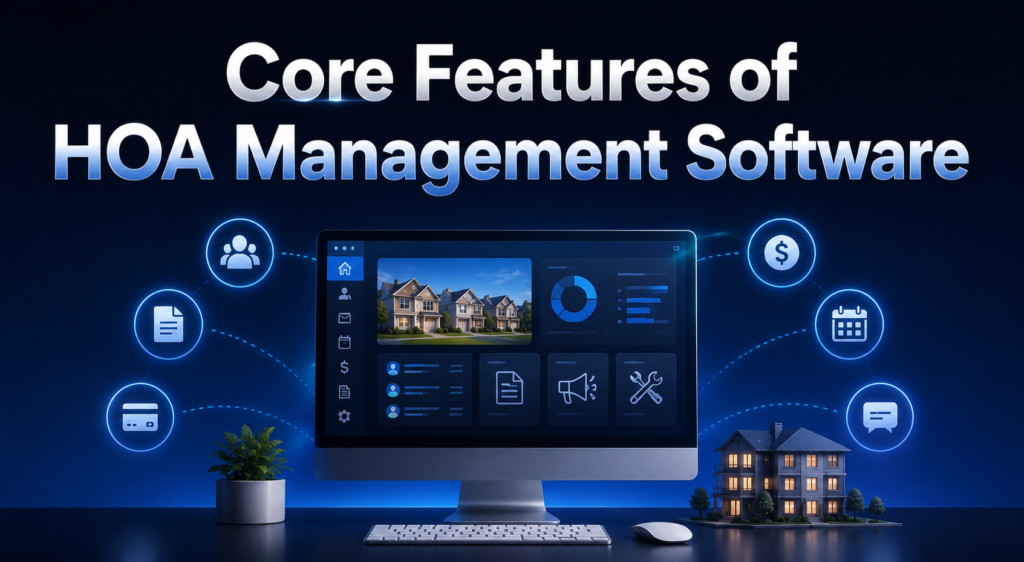
Every reliable HOA management software solution includes a set of essential features designed to cover financial, administrative, and communication needs. These features work together to create a smoother experience for both board members and residents.
Accounting and Financial Management
This feature allows associations to manage budgets, track expenses, and generate financial reports without manual calculations. It ensures transparency by giving board members real time visibility into the community’s financial health. Accurate accounting also builds trust among residents who want to see how their dues are being used.
Online Dues and Payment Collection
Residents can pay their monthly or annual dues directly through an online portal instead of mailing checks. This feature reduces late payments by offering reminders and multiple payment options such as bank transfers or cards. It also saves board members from manually recording every transaction by hand.
Resident or Owner Portal
A dedicated portal gives homeowners access to their account details, payment history, and community announcements in one place. It creates a self-service environment where residents do not need to contact the board for routine information. This convenience significantly reduces the workload of volunteer board members.
Communication Tools
Built-in email, SMS, and announcement features allow boards to share updates instantly with the entire community. Instead of relying on printed notices or word of mouth, information reaches everyone at the same time. Clear communication reduces misunderstandings and keeps residents informed about important decisions.
Document Storage and Management
HOA management software allows associations to store bylaws, meeting minutes, contracts, and other important files digitally. This eliminates the risk of losing paperwork and makes it easy to retrieve documents whenever needed. Board members can also share these files with residents through the same portal.
Maintenance and Work Order Tracking
This feature lets residents submit maintenance requests online, which are then assigned to vendors or staff for resolution. Boards can track the status of each request from submission to completion without confusion. It creates accountability and ensures nothing gets forgotten or delayed.
Violation and Compliance Tracking
Boards can log community rule violations, send notices, and track resolution progress directly within the system. This keeps enforcement consistent and fair across all residents rather than relying on memory or informal notes. It also creates a documented history in case disputes arise later.
Architectural Request Management
Homeowners often need approval before making changes to their property, such as building a fence or repainting exteriors. This feature allows residents to submit requests online and boards to review and approve them digitally. It speeds up what used to be a slow, paperwork heavy process.
Meeting Scheduling and Voting
Boards can schedule meetings, send reminders, and even conduct elections or votes electronically through the software. This increases participation since residents can vote remotely instead of attending in person. It also creates a transparent and recorded voting history for future reference.
Reporting and Analytics
Detailed reports on finances, maintenance trends, and resident engagement help boards make informed decisions. These insights allow associations to plan budgets more accurately and identify recurring issues early. Data driven decision making becomes far easier with built-in analytics tools.
Benefits of Using HOA Management Software
Adopting HOA management software brings measurable improvements to how communities operate on a daily basis. These benefits extend to board members, residents, and property managers alike.
Time Saving Automation
Automated reminders, invoicing, and reporting free up hours that would otherwise be spent on manual administrative work. Board members, who are often volunteers with limited time, can focus on bigger community priorities instead. This efficiency is one of the biggest reasons associations switch to digital tools.
Improved Transparency for Residents
Residents gain direct access to financial records, meeting minutes, and community updates whenever they want. This openness builds trust between the board and homeowners, reducing suspicion or complaints. Transparency becomes a natural byproduct of using a centralized system.
Better Financial Accuracy
Automated accounting reduces the chances of human error in calculations, invoicing, and record keeping. Boards can generate accurate financial statements quickly instead of manually reconciling numbers. This accuracy is especially valuable during audits or annual reviews.
Enhanced Communication
Instant notifications and centralized messaging ensure that no resident misses important community updates. Communication becomes more consistent and professional compared to informal methods like flyers or word of mouth. This ultimately strengthens the relationship between the board and its residents.
Reduced Paperwork
Digital document storage eliminates the need for physical filing cabinets full of contracts and records. Everything becomes searchable and accessible within seconds instead of being buried in paper files. This also protects important documents from being lost or damaged over time.
Scalability for Growing Communities
As communities grow larger, manual management becomes increasingly difficult to sustain. HOA management software scales easily, allowing associations to manage hundreds of units with the same level of efficiency. This makes it a long term solution rather than a temporary fix.
Who Uses HOA Management Software
A wide range of organizations rely on HOA management software to simplify their daily operations. Understanding who uses it helps clarify how flexible and valuable this technology really is.
Property Management Companies
These companies often manage multiple HOAs at once, making centralized software essential for efficiency. It allows them to handle accounting, communication, and maintenance across different communities from one dashboard. This reduces administrative overhead significantly compared to manual multi-community management.
Self-Managed HOA Boards
Smaller associations without a professional management company still need organized systems to function properly. Volunteer board members benefit from software that automates repetitive tasks like dues collection and reporting. It essentially acts as a virtual assistant for boards with limited resources.
Condo Associations
Condo associations often deal with shared amenities and stricter rules, making tracking and compliance more complex. HOA management software helps them manage violations, maintenance requests, and resident communication smoothly. This structure is especially useful in high density living environments.
Community Associations
Larger community associations with extensive amenities, such as pools or clubhouses, require detailed scheduling and financial tracking. Software helps coordinate these resources while keeping residents informed about availability and rules. This level of organization would be nearly impossible to maintain manually at scale.
Key Considerations Before Choosing Software
Selecting the right HOA management software requires careful evaluation of community needs and long term goals. The following considerations help narrow down the best option for any association.
Size of the Community
Smaller communities may only need basic features like payment collection and communication tools. Larger communities require more advanced systems capable of handling complex accounting and multiple amenities. Matching software capability to community size prevents overpaying for unnecessary features.
Budget
Pricing varies widely depending on the number of units and features included in the package. Associations should compare costs against the value gained through time savings and reduced errors. A clear budget helps avoid selecting software that strains the community’s finances.
Ease of Use
Since board members are often volunteers without technical backgrounds, the software must be simple to navigate. Complicated systems can lead to underutilization and frustration among users. An intuitive interface ensures higher adoption rates across the board and residents.
Integration Capabilities
The ability to connect with existing accounting tools, payment processors, or communication platforms is important. Good integration prevents duplicate data entry and keeps information consistent across systems. This becomes especially important for associations already using other administrative tools.
Customer Support
Reliable customer support ensures that technical issues are resolved quickly without disrupting daily operations. Associations should look for providers offering responsive support through multiple channels like chat, email, or phone. Strong support becomes crucial during the initial transition period.
Security and Data Privacy
Since financial and personal resident data is stored within the system, strong security measures are non negotiable. Associations should verify encryption standards and data protection policies before committing to any provider. This protects both the community and its residents from potential data breaches.
Popular HOA Management Software Options
Several established providers dominate the HOA management software market, each offering slightly different strengths. Comparing them helps associations identify the best fit for their specific needs.
AppFolio
AppFolio is widely used by property management companies handling multiple communities simultaneously. It offers strong accounting features combined with resident communication tools in one platform. Its scalability makes it a popular choice for larger management portfolios.
Buildium
Buildium is known for its user friendly interface and comprehensive financial reporting capabilities. It caters well to both property managers and self-managed associations looking for flexibility. Many users appreciate its balance between simplicity and functionality.
TownSq
TownSq focuses heavily on resident engagement through a mobile friendly portal and communication tools. It is particularly popular among communities that prioritize resident experience and transparency. Its design leans toward making everyday interactions smoother for homeowners.
Vantaca
Vantaca is built specifically for larger management companies overseeing numerous associations at once. It offers advanced automation and workflow tools designed to handle complex operational needs. This makes it a strong choice for enterprise level property management businesses.
PayHOA
PayHOA is designed with smaller, self-managed associations in mind, offering affordable and straightforward tools. It covers essential features like payments, communication, and document storage without unnecessary complexity. This makes it accessible for communities with limited budgets.
CINC Systems
CINC Systems provides robust accounting tools tailored specifically for community association management. It is often chosen by associations that prioritize financial accuracy and detailed reporting. Its focus on compliance also appeals to communities with strict regulatory requirements.
Comparison Table
| Software | Best For | Key Strength |
| AppFolio | Property management companies | Scalable accounting and communication |
| Buildium | Self-managed and managed HOAs | User friendly financial reporting |
| TownSq | Resident engagement focused communities | Mobile portal experience |
| Vantaca | Large management companies | Advanced workflow automation |
| PayHOA | Small self-managed HOAs | Affordable essential features |
| CINC Systems | Compliance focused associations | Detailed financial accuracy |
How to Implement HOA Software Successfully
Choosing the right software is only half the process, since successful implementation determines how effectively it will be used. A structured rollout ensures smoother adoption across the entire community.
Steps for Onboarding
Implementation should begin with clearly defining goals and mapping existing processes to the new system. Setting up accounts, importing resident data, and configuring payment options are essential early steps. A phased rollout often works better than switching everything at once.
Training Board Members and Residents
Board members need thorough training since they will manage the system daily on behalf of the community. Residents also benefit from simple guides explaining how to use the portal for payments and requests. Proper training reduces confusion and increases overall satisfaction with the new system.
Data Migration Tips
Migrating old financial records and resident information must be done carefully to avoid data loss or errors. It is wise to run both old and new systems in parallel briefly before fully switching over. This ensures accuracy and gives time to catch any migration mistakes.
Common Implementation Mistakes to Avoid
Rushing the rollout without proper training often leads to low adoption rates among residents and board members. Failing to communicate the change clearly can also create resistance or confusion within the community. Avoiding these mistakes ensures a smoother transition and long term success.
Future Trends in HOA Management Software
Technology continues to evolve, and HOA management software is following broader digital trends shaping the industry. Staying aware of these trends helps associations choose future-proof solutions.
AI Powered Automation
Artificial intelligence is increasingly being used to automate repetitive tasks like payment reminders and violation notices. This reduces manual workload even further while improving response times for residents. AI driven insights are also helping boards make smarter financial decisions.
Mobile First Solutions
More providers are prioritizing mobile apps to give residents and board members access on the go. This shift reflects how people increasingly prefer handling tasks directly from their smartphones. Mobile accessibility is quickly becoming a standard expectation rather than an added feature.
Enhanced Cybersecurity
As data breaches become more common across industries, HOA management software providers are investing heavily in security. Stronger encryption and multi factor authentication are becoming standard practices. This protects sensitive financial and personal information from potential threats.
Integration with Smart Home and IoT
Some communities are beginning to integrate smart home devices with their management systems for amenities like gates or lighting. This creates a more connected living experience for residents. While still emerging, this trend points toward greater automation in community management overall.
Conclusion
HOA management software has become an essential tool for associations looking to simplify operations and improve resident satisfaction. From accounting to communication and compliance, it covers every major responsibility boards face daily.
Choosing the right solution depends on community size, budget, and specific feature needs, but the long term benefits consistently outweigh the initial investment.
FAQs
What does HOA software typically cost?
Pricing usually depends on the number of units managed and the features included in the package. Smaller associations can find affordable options, while larger communities may pay more for advanced tools. It is best to request quotes from multiple providers before deciding.
Is HOA management software secure?
Most reputable providers implement strong encryption and security protocols to protect financial and personal data. Associations should still verify a provider’s security policies before signing up. This ensures resident information remains safe from potential breaches.
Can small HOAs benefit from it too?
Yes, even small associations benefit significantly from automated dues collection and simplified communication. Affordable options like PayHOA are specifically designed for smaller, self-managed communities. The efficiency gained often outweighs the modest cost involved.
How long does implementation take?
Implementation timelines vary depending on community size and the complexity of data migration involved. Smaller associations may complete the process within a few weeks, while larger ones could take longer. Proper planning and training significantly speed up the overall transition.
Related Articles
SmartMusic Software: A Complete Guide for Students and Teachers
MBAM Software: A Complete Guide to Malwarebytes Anti-Malware
Corporate Software Inspector: A Complete Guide to Enterprise Vulnerability Management
Chaturbate Software Engineer: Complete Career Guide
Senior Software Engineer Aerial Platform: A Complete Career Guide


