

Embroidery Software for Mac: 8 Best Options Compared
September 2, 2026
Equipment Management Software: A Complete Guide to Features, Benefits and Uses
September 3, 2026
Managing large family wealth is not a simple task, especially when assets are spread across banks, private investments, real estate, and multiple countries. Family office software was created to solve exactly this problem by bringing every financial detail into one organized system.
It helps families and their advisors track investments, manage accounting, and stay compliant without relying on scattered spreadsheets. As wealth becomes more complex, this type of software is no longer a luxury but a practical necessity.
This guide explains everything about family office software in a simple, easy-to-follow manner, from its core features to future trends shaping the industry.
Understanding Family Office Software
Before exploring features, it helps to understand what a family office actually is and why regular financial tools are not enough for it. This section breaks down both ideas in simple terms.
What Is a Family Office?
A family office is a private organization set up to manage the financial and personal affairs of a wealthy family.
It usually handles investments, tax planning, estate matters, and daily financial administration. Some families run a single-family office just for themselves, while others use a multi-family office that serves several wealthy households together.
Why Family Offices Need Specialized Software
Regular accounting or banking apps are built for simple, single-account use, not for complex, multi-entity wealth structures.
Family office software is designed specifically to handle multiple currencies, custodians, trusts, and asset classes in one place. This specialization is what makes it far more useful than generic financial tools for high-net-worth families.
Core Features of Family Office Software
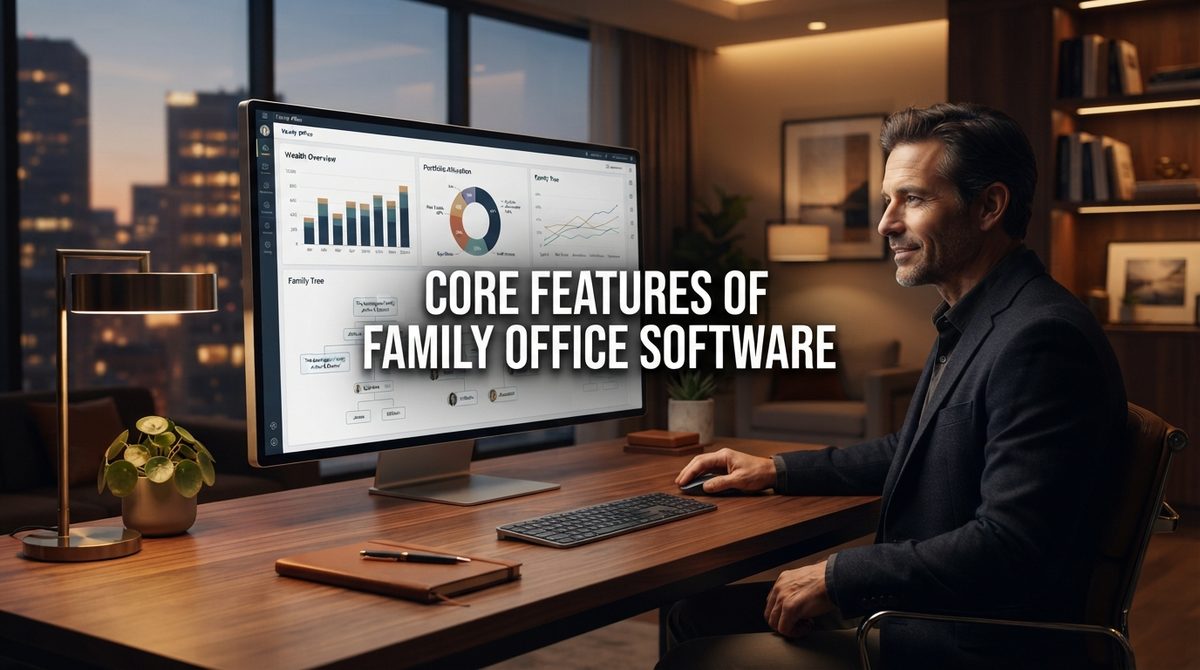
Every good platform in this category is built around a few essential functions that make daily wealth management easier. These features work together to give families a complete financial picture at any moment.
Portfolio and Investment Management
This feature allows families to track stocks, bonds, private equity, real estate, and other holdings from a single dashboard.
It shows real-time performance, asset allocation, and historical trends without needing to check multiple bank portals. Good family office software updates this data automatically to reduce manual work.
Reporting, Accounting and Compliance Tools
Consolidated reporting pulls data from various banks and custodians into one clear statement, saving hours of manual reconciliation.
Built-in accounting modules handle bookkeeping, general ledgers, and multi-entity transactions with accuracy. Compliance tools also keep audit trails ready, which is essential during tax season or regulatory reviews.
Client Portals and Document Management
Secure online portals let family members view their financial summaries anytime through a computer or mobile device.
Document management systems store wills, trust agreements, and tax records safely in encrypted digital vaults. This reduces paperwork while keeping sensitive information protected from unauthorized access.
Benefits of Using Family Office Software
Adopting the right platform brings noticeable improvements to how a family office operates daily. The advantages go beyond convenience and directly affect decision-making and long-term wealth protection.
Centralized and Accurate Data
Instead of juggling multiple spreadsheets, everything is stored in one reliable system, reducing the chance of costly errors.
Family office software gives a single source of truth for all financial activities across accounts. This consistency builds trust between family members and their advisory teams.
Time Savings and Better Decisions
Automation of routine tasks like reconciliation and reporting frees up significant time for advisors and family staff. With real-time analytics, families can make faster, more informed investment decisions. Over time, this efficiency translates into better financial outcomes and reduced administrative costs.
Challenges to Consider Before Adopting
No system is perfect, and family office software comes with its own set of practical challenges. Understanding these in advance helps families prepare for a smoother transition.
Integration and Cost Issues
Connecting data from multiple banks, custodians, and legacy systems can be technically difficult and time-consuming. High-quality platforms also come with a significant price tag, which may not suit smaller family offices. Careful budgeting and planning are necessary before committing to a specific solution.
Security and Training Concerns
Since family office software stores extremely sensitive financial data, cybersecurity risks must be taken seriously.
Staff also need proper training to use the system effectively, which can slow down initial adoption. Choosing a vendor with strong security certifications and good onboarding support reduces these risks considerably.
How to Choose the Right Family Office Software
Selecting the right platform requires more than comparing feature lists on a website. It depends heavily on the specific size, complexity, and goals of the family office in question.
Assess Your Needs First
Every family office should start by listing must-have features versus nice-to-have extras based on their actual portfolio complexity.
A single-family office with straightforward holdings may need far less than a multi-family office managing dozens of clients. This clarity prevents overspending on unnecessary functionality.
Compare Pricing and Support
Pricing models vary widely, including flat subscriptions, percentage-of-assets fees, and one-time licensing costs. It’s important to evaluate ongoing customer support quality, not just the initial sales pitch. A responsive support team often matters more long-term than a slightly cheaper monthly rate.
Leading Family Office Software Providers
The market offers several established platforms, each with different strengths depending on family office size and needs. Comparing them side by side makes the selection process much easier.
| Provider | Best Suited For | Key Strength |
| Addepar | Large multi-asset portfolios | Advanced data aggregation and analytics |
| Eton Solutions | Complex multi-entity families | End-to-end operational outsourcing |
| Masttro | High-net-worth reporting needs | Clean, intuitive reporting dashboards |
| Black Diamond (SS&C) | Advisory firms and family offices | Strong integration ecosystem |
| Orion Advisor Tech | Wealth advisors serving families | Comprehensive portfolio management tools |
Each of these providers competes on data accuracy, ease of integration, and reporting depth, so the right choice ultimately depends on a family’s specific structure and budget.
Future of Family Office Software
Technology in this space continues to evolve quickly, shaping how future family offices will operate. Two trends stand out as particularly influential going forward.
AI and Automation
Artificial intelligence is increasingly used to spot patterns, forecast risks, and automate repetitive reporting tasks. This reduces human error and allows advisors to focus more on strategy than manual data entry. Family office software with AI capabilities is quickly becoming a competitive advantage.
Digital Assets and ESG Tracking
Many platforms are now adding support for cryptocurrency and other digital assets alongside traditional holdings. There is also growing demand for ESG and impact-investing tracking as younger generations inherit family wealth. Future software will likely blend these priorities into standard reporting features.
Conclusion
Family office software has become an essential tool for managing complex, multi-generational wealth efficiently and securely. It centralizes data, automates reporting, and reduces the manual workload that once burdened family offices.
While costs and integration challenges exist, the long-term benefits in accuracy, security, and decision-making make it a worthwhile investment for most wealthy families today.
FAQs
What does family office software typically cost?
Pricing varies from a few hundred to several thousand dollars monthly, depending on features and portfolio size.
Can small family offices benefit from this software?
Yes, many providers now offer scaled-down versions suitable for smaller, less complex family offices.
Is family office software secure?
Reputable platforms use bank-level encryption and strict compliance standards to protect sensitive financial data.
How long does implementation usually take?
Implementation can range from a few weeks to several months, depending on data complexity and integrations.
How is family office software different from regular wealth management software?
It is built specifically for multi-entity, multi-generational wealth structures, unlike generic tools built for individual investors.
Related Articles
Types of Computer Software: A Complete Beginner-Friendly Guide
Software Engineer Remote: The Complete Career Guide


