

GoPerfect AI Recruitment Software: The Complete Guide for Modern Hiring Teams
July 14, 2026
Vetter Software: A Complete Guide to Vetting and Verification Tools
July 14, 2026
Lab automation software is a digital solution that helps laboratories control instruments, manage samples, and organize workflows without relying on manual effort. It connects machines, data systems, and people into one smooth working process.
Labs use this software to reduce human error, save time, and handle large volumes of testing with better accuracy. From pharmaceutical companies to diagnostic centers, this technology is becoming a core part of daily lab operations.
This guide explains everything about lab automation software in a simple and detailed manner, covering its features, benefits, top tools, and future direction.
What Is Lab Automation Software?
At its core, lab automation software acts as the digital brain of a laboratory, guiding instruments and managing information automatically. It replaces repetitive manual tasks with organized, computer-controlled processes.
Basic Definition and Purpose
Lab automation software is a system designed to control laboratory equipment, track samples, and manage data flow between different devices. It removes the need for staff to manually operate every machine, reducing delays and mistakes. The main purpose is to make lab work faster, safer, and more consistent across every test cycle.
How It Fits Into a Laboratory Setup
This software usually connects with liquid handlers, plate readers, incubators, and analyzers through a central control system. It receives instructions, sends commands to machines, and collects results automatically. Because everything is linked digitally, staff can monitor multiple processes from a single screen instead of checking each machine separately.
Types of Lab Automation Software
There are several categories of lab automation software, each designed for a specific function within the lab. Understanding these types helps in choosing the right combination for a particular workflow.
Laboratory Information Management Systems (LIMS)
LIMS software manages sample tracking, test results, and reporting from start to finish. It keeps a digital record of every sample’s journey, including who handled it and what tests were performed. Many labs rely on LIMS as the backbone of their data management system.
Electronic Lab Notebooks (ELN)
An ELN replaces paper notebooks with a digital platform where researchers record experiments, observations, and results. It allows easy searching, sharing, and long-term storage of scientific data. ELNs are especially useful in research-heavy environments where documentation accuracy matters.
Instrument Control and Scheduling Software
This type of software directly manages robotic arms, liquid handlers, and other lab machines. It schedules tasks so that multiple instruments can work together without conflicts or downtime. It is commonly used in high-throughput labs handling large sample volumes.
Laboratory Execution Systems (LES)
LES software guides staff step-by-step through standard procedures to ensure consistency. It reduces the chance of skipped steps or incorrect sequences during testing. This type is often used in regulated industries where every action needs to be documented precisely.
Core Features of Lab Automation Software
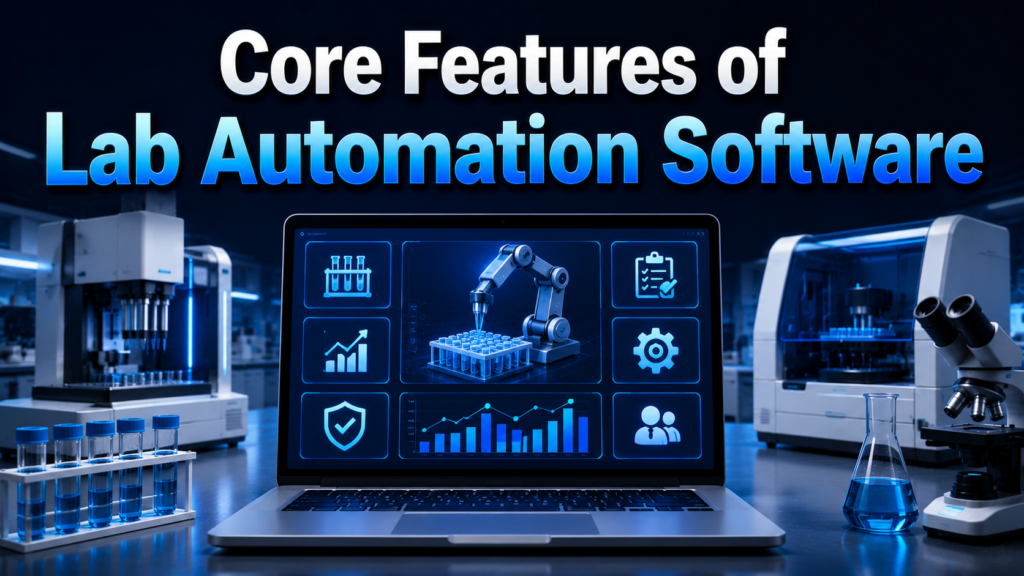
Most lab automation software shares a common set of features designed to keep operations smooth and accurate. These features work together to reduce manual workload and improve reliability.
Sample Tracking and Management
Every sample entering the lab is tagged and monitored through its complete lifecycle. This feature prevents mix-ups and gives instant visibility into where each sample stands in the process. It also helps in maintaining a clear chain of custody for compliance purposes.
Workflow Scheduling and Task Orchestration
The software arranges tasks in the correct order and timing, matching them to available instruments. This prevents bottlenecks and ensures machines are used efficiently throughout the day. Scheduling also helps labs plan for peak workloads without overloading any single device.
Data Capture and Integration
Results from instruments are automatically recorded and stored without manual entry. This reduces transcription errors and speeds up reporting. The data is often integrated with other systems like LIMS or ELN for a complete record.
Quality Control and Compliance Tracking
Built-in checks catch errors before they affect final results, flagging any unusual readings for review. The system also keeps audit trails required for regulatory standards. This is particularly important for labs working under strict guidelines like GLP or GMP.
The table below summarizes these features at a glance:
| Feature | What It Does | Who Benefits Most |
| Sample Tracking | Monitors sample location and status | Diagnostic and clinical labs |
| Workflow Scheduling | Coordinates instrument usage and timing | High-throughput research labs |
| Data Integration | Automates data collection and storage | Pharma and biotech companies |
| Quality Control | Flags errors and maintains audit trails | Regulated industries |
Benefits of Using Lab Automation Software
Adopting lab automation software brings measurable improvements across accuracy, speed, and cost management. These advantages make it a valuable investment for labs of all sizes.
Improved Accuracy and Reduced Errors
Manual processes are prone to human mistakes, especially during repetitive tasks. Automation minimizes these errors by following programmed instructions consistently every time. This leads to more reliable results and fewer repeated tests.
Faster Turnaround and Higher Efficiency
Automated systems can run continuously without breaks, completing tasks much faster than manual methods. This is especially valuable for labs handling large sample volumes daily. Faster results also mean quicker decision-making for clinical and research purposes.
Long-Term Cost Savings
Although the initial setup cost can be high, automation reduces expenses over time by lowering labor needs and minimizing wasted materials. Fewer errors also mean fewer repeated experiments, saving both time and money. Over several years, most labs see a strong return on their investment.
Challenges and Limitations
While lab automation software offers many benefits, it also comes with certain challenges that labs must plan for before adoption.
High Initial Investment
Setting up automation software along with compatible instruments can require a significant upfront budget. Smaller labs may find this cost difficult to justify immediately. However, phased implementation can help spread the investment over time.
Integration with Older Equipment
Many labs still use older machines that were not built to connect with modern software. Bridging this gap sometimes requires additional middleware or hardware upgrades. This can extend implementation timelines beyond initial expectations.
Staff Training Requirements
Employees need proper training to operate new systems confidently and safely. Without adequate training, the benefits of automation may not be fully realized. Ongoing support and refresher sessions are often necessary as software updates roll out.
Popular Lab Automation Software and Vendors
Several established vendors offer reliable lab automation software, each with its own strengths depending on lab size and industry focus.
| Vendor | Product Name | Best Suited For |
| Hamilton | Venus Software | Liquid handling automation |
| Tecan | FluentControl | High-throughput screening |
| Thermo Fisher | Momentum | Multi-instrument workflow control |
| Beckman Coulter | Automation Solutions | Clinical and research labs |
| Benchling | ELN and LIMS | Biotech and research documentation |
| Titian Software | Mosaic | Sample and inventory management |
Each of these platforms has been developed to serve specific laboratory needs, so choosing between them depends heavily on the type of work a lab performs and its existing infrastructure.
Industries Using Lab Automation Software
A wide range of industries have adopted lab automation software to improve their daily operations and research capabilities.
Pharmaceutical companies use it for drug discovery and high-throughput screening, where thousands of samples need testing quickly. Clinical diagnostic labs rely on automation to process patient samples with speed and accuracy, directly impacting patient care timelines. Genomics and sequencing labs use automation to handle complex, data-heavy workflows that would be extremely time-consuming manually.
Academic and research institutions also benefit, especially when handling repetitive experiments across multiple projects. Food safety and environmental testing labs use automation to maintain consistent testing standards across large batches of samples.
How to Choose the Right Lab Automation Software
Selecting the right system requires careful evaluation of a lab’s specific needs and long-term goals rather than choosing based on popularity alone.
Assess Your Lab’s Specific Needs
Start by identifying which tasks consume the most time and where errors occur most frequently. This helps in choosing software that addresses actual pain points rather than adding unnecessary features. A clear needs assessment also prevents overspending on capabilities that won’t be used.
Consider Integration and Scalability
The chosen software should work well with existing instruments and allow for future expansion. Labs growing in sample volume need systems that can scale without requiring a complete overhaul later. Checking compatibility with current equipment early on saves significant rework.
Check Compliance and Vendor Support
Make sure the software meets industry-specific regulations such as GLP, GMP, or FDA requirements where applicable. Reliable vendor support and training resources are equally important for smooth long-term use. Reading user reviews and requesting demonstrations can also guide a confident decision.
Future Trends in Lab Automation Software
The field of lab automation software continues to evolve, with new technologies shaping how labs will operate in coming years.
Artificial Intelligence and Predictive Analytics
AI is increasingly being used to predict equipment maintenance needs and flag unusual results before they cause problems. This adds a layer of intelligence beyond simple task automation. Predictive analytics also helps labs plan resources more effectively.
Cloud-Based and Remote Lab Management
Cloud platforms allow lab data and controls to be accessed from anywhere, supporting remote monitoring and collaboration. This is particularly useful for organizations with multiple lab locations. Cloud systems also simplify software updates and data backup processes.
Fully Autonomous Lab Systems
Some research institutions are experimenting with labs that run experiments with minimal human involvement, guided entirely by software and robotics. While still emerging, this trend points toward a future where lab automation software plays an even larger decision-making role. These “self-driving labs” could dramatically speed up scientific discovery over the next decade.
Frequently Asked Questions
What is the difference between LIMS and ELN?
LIMS focuses on managing samples and test results, while ELN is used for recording experiments and observations in a digital notebook format. Many labs use both together for complete data coverage.
Is lab automation software expensive for small labs?
Initial costs can be high, but many vendors now offer scalable or modular solutions suited to smaller budgets. Long-term savings often justify the investment over time.
How long does implementation usually take?
Implementation timelines vary based on lab size and existing infrastructure, ranging from a few weeks to several months. Proper planning helps avoid unnecessary delays.
Is the data handled by this software secure?
Most reputable lab automation software includes strong security measures and compliance features to protect sensitive data. Choosing established vendors reduces security risks significantly.
Conclusion
Lab automation software has become an essential tool for laboratories aiming to improve accuracy, speed, and overall efficiency. While there are challenges like initial costs and training needs, the long-term benefits typically outweigh these hurdles.
Labs that carefully assess their needs and choose compatible, scalable solutions are best positioned to gain lasting value from automation. As technology continues advancing, lab automation software will keep playing a bigger role in shaping the future of scientific and diagnostic work.
Related Articles
VoIP Software Skype: A Complete and Simple Guide
Axialys Pricing Call Center Software France: Complete Cost Guide
Credit Management Software: A Complete Guide for Businesses
Healthcare Contract Management Software: A Complete Guide
Software Engineering Manager Jobs: A Complete Career Guide


