
Chicago Custom Software Development: The Complete Guide for Businesses
July 10, 2026
Healthtech Software Development: A Complete Guide
July 10, 2026
Custom MVP software development is the process of building a Minimum Viable Product that is designed around your specific business idea instead of a generic template. It focuses on core features only, so you can test your concept in the real market without spending months and a huge budget on a full product.
This approach helps startups validate their idea, attract investors, and collect genuine user feedback early. In this guide, we will explain every part of custom MVP software development in simple words so you can plan your own product journey with confidence.
Understanding MVP: The Basics
Before jumping into custom development, it is important to understand what an MVP actually means and where this idea came from. The next few points explain the foundation clearly.
The Origin of the MVP Concept
The term MVP became popular through the Lean Startup methodology, which encourages founders to build, measure, and learn quickly instead of planning for years. The idea is simple: release a basic working version of your product, watch how real users react, and improve it step by step. This method saves both time and money for new businesses.
MVP vs Prototype vs Proof of Concept
Many people confuse these three terms, but they are different stages of product development. A proof of concept simply checks if an idea is technically possible, a prototype shows how the product might look and feel, and an MVP is an actual working product that real users can use. Understanding this difference helps you plan your budget and timeline correctly.
Why Most MVPs Fail
Most MVPs fail because founders add too many features, ignore user feedback, or build the product without proper market research. Some also choose the wrong development partner who does not understand their business goals. Avoiding these mistakes early can save a lot of time and investment later.
What Makes an MVP “Custom”?
Not every MVP is built the same way, and choosing a custom approach changes the outcome significantly. Below is a simple explanation of what “custom” really means here.
Custom vs Template-Based vs No-Code MVPs
A template-based or no-code MVP uses ready-made tools, which are fast but limited when your idea needs unique logic or design. A custom MVP, on the other hand, is coded from scratch based on your exact requirements, giving you more flexibility and control. This makes custom development a better long-term choice for businesses planning to scale.
Benefits of Choosing Custom Development
Custom MVP software development gives you full ownership of the code, better security, and the freedom to add advanced features later without technical limitations. It also allows the product to reflect your brand and workflow exactly the way you imagined it. These benefits make it a preferred choice for serious startups.
When Custom MVP Development Is the Right Choice
If your business idea involves unique processes, complex user roles, or plans for future scaling, custom MVP development is the right path. It is also ideal when you are raising investment, since investors usually prefer a well-built, scalable product over a basic no-code app.
Why Businesses Need Custom MVP Development
Building an MVP is not just about saving money — it plays a strategic role in the growth of a business. Custom MVP software development allows founders to test real assumptions before committing to full-scale investment.
It helps in validating the business idea with actual users instead of guesses, which reduces the risk of building something nobody wants. It also plays a major role in attracting investors, since a working product builds more trust than just a pitch deck. Additionally, launching a lean version speeds up your time-to-market, keeps your financial risk low, and lets you gather honest feedback that shapes the final product direction.
Key Features of a Successful Custom MVP
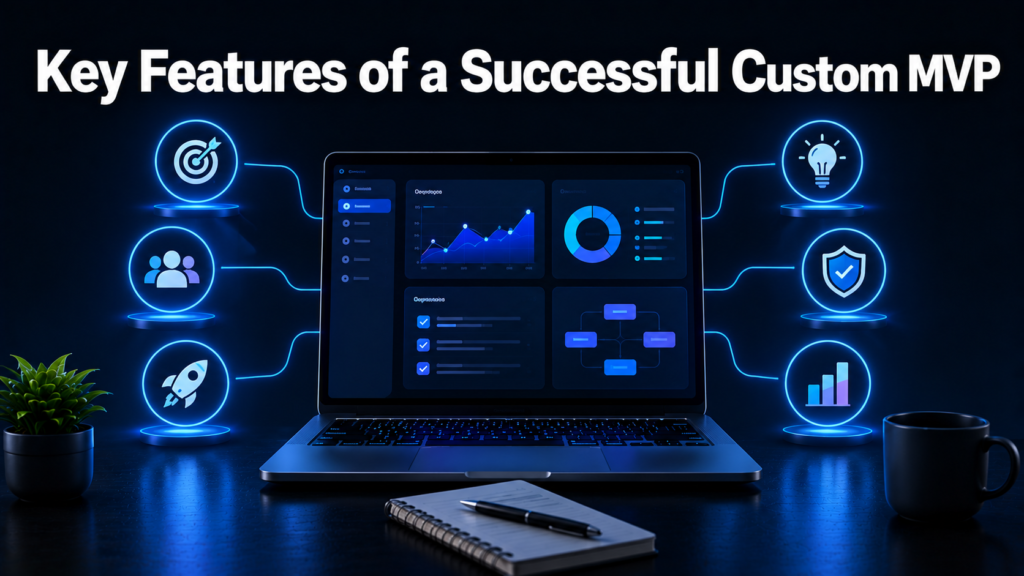
A well-built MVP is not about having many features — it is about having the right ones. The table below highlights the core elements that make an MVP successful.
| Feature | Why It Matters |
| Core Functionality Only | Keeps the product focused and easy to test |
| User-Centric Design | Makes the app simple and enjoyable to use |
| Scalable Architecture | Allows easy upgrades as the business grows |
| Basic Security & Compliance | Protects user data from day one |
| Fast Performance | Keeps users engaged and reduces drop-off |
Step-by-Step Custom MVP Development Process
Every successful MVP follows a structured process rather than random development. Below is a simplified breakdown of the typical stages involved.
| Step | What Happens |
| Idea Validation | Research the market and confirm demand |
| Feature Prioritization | Select only the most essential features |
| Wireframing & Design | Create a simple visual layout of the app |
| Tech Stack Selection | Choose tools suited to your product needs |
| Agile Development | Build the product in small, testable sprints |
| Testing & QA | Fix bugs and ensure smooth performance |
| Launch & Deployment | Release the MVP to real users |
| Feedback & Iteration | Improve the product based on user response |
This structured flow keeps the custom MVP software development process organized and reduces unnecessary delays.
How to Choose the Right Tech Stack for Your MVP
Choosing the right technology is one of the most important decisions in the entire development journey. It directly affects the app’s speed, scalability, and future development cost.
Frontend technologies control how the app looks and feels to users, while backend technologies handle the logic and data processing behind the scenes. The database stores all user and product information securely, and cloud hosting ensures the app stays online and performs well under load.
When selecting these tools, businesses should also think about long-term scalability, overall cost, and whether their development team is skilled in that particular technology.
Cost of Custom MVP Software Development
The cost of building an MVP depends on several factors, and there is no fixed price that applies to every business. Below is a general overview to help you understand pricing ranges.
| Complexity Level | Estimated Features | Typical Cost Range |
| Simple MVP | Basic app with 3-5 core features | Lower budget range |
| Moderate MVP | Multiple user roles, integrations | Mid-range budget |
| Complex MVP | Advanced logic, payments, real-time features | Higher budget range |
Costs can be reduced without lowering quality by keeping the feature list minimal, choosing an experienced outsourcing partner, and reusing proven open-source tools wherever possible.
Timeline: How Long Does It Take to Build a Custom MVP?
Most custom MVPs take a few weeks to a few months, depending on complexity and the size of the development team. A simple MVP with basic features can be completed faster, while apps with advanced functionality, integrations, or multiple user roles naturally take longer to build and test. Founders should set realistic expectations and avoid rushing the process, since proper testing plays a big role in the final product’s success.
In-House Team vs Outsourcing vs Freelancers
Choosing who will build your MVP is just as important as choosing what to build. Each option has its own advantages depending on your budget and control needs.
| Option | Best For | Consideration |
| In-House Team | Long-term products with ongoing updates | Higher cost, more control |
| Outsourcing Agency | Startups needing full expertise fast | Reliable process, moderate cost |
| Freelancers | Small budgets, simple MVPs | Less structure, variable quality |
How to Choose the Right MVP Development Company
Picking the right partner can make or break your MVP journey. This section explains the qualities and questions that matter most before signing a contract.
Key Qualities to Look For
A good development partner should have proven experience in custom MVP software development, clear communication, and a transparent pricing structure. They should also show genuine interest in understanding your business goals rather than just following instructions blindly.
Questions to Ask Before Hiring
Before finalizing a partner, ask about their previous MVP projects, average timelines, post-launch support, and how they handle change requests during development. Their answers will reveal how organized and reliable their process really is.
Red Flags to Avoid
Be cautious of companies that promise unrealistically low prices, avoid sharing past client work, or rush you into signing without proper discussion. These signs often lead to poor quality or delayed delivery later.
Common Mistakes to Avoid in MVP Development
Even with the right partner, certain mistakes can slow down your progress or waste your budget. The most common ones include overloading the MVP with unnecessary features, ignoring early user feedback, skipping proper market research, choosing a mismatched tech stack, and allowing scope creep during development. Staying aware of these mistakes helps keep the project on track and within budget.
From MVP to Full-Scale Product
Once your MVP is live, the real work of growth begins. Analyzing performance metrics helps you understand which features users love and which ones need improvement. Based on this data, businesses can decide what new features to add next, plan for a more scalable architecture, and often use the MVP’s success as proof to secure further funding for full-scale development.
Industries That Benefit Most
Custom MVP software development is widely used across several industries, including FinTech, HealthTech, E-commerce, EdTech, and SaaS-based businesses. These industries often deal with unique workflows and compliance needs, making a custom-built MVP far more suitable than a generic template.
Competitor Analysis Overview
Most companies offering MVP development fall into two categories: large agencies that focus on enterprise-level projects with higher costs, and smaller specialized studios that focus purely on startup MVPs with faster turnaround. The main difference usually lies in communication speed, pricing flexibility, and how well they understand early-stage business needs. Comparing a few options based on portfolio, client reviews, and post-launch support is a practical way to choose the right fit.
Frequently Asked Questions
How much does a custom MVP cost?
The cost depends on complexity, but most simple MVPs are more affordable than a full product build.
How long does MVP development take?
Typically a few weeks to a few months, depending on features and team size.
Can I upgrade my MVP later?
Yes, a well-built custom MVP is designed to scale into a full product over time.
Do I need a technical co-founder?
Not necessarily, since a good development partner can guide the technical side for you.
What is the difference between an MVP and a full product?
An MVP includes only core features to test the idea, while a full product includes complete functionality for long-term use.
Conclusion
Custom MVP software development gives startups a practical way to test their ideas without heavy upfront investment. By focusing on core features, choosing the right tech stack, and partnering with an experienced team, businesses can launch faster and grow with confidence based on real user feedback.
Related Articles
Software Audio Console: Complete Guide to Digital Mixing
VoIP Software Skype: A Complete and Simple Guide
Axialys Pricing Call Center Software France: Complete Cost Guide
Credit Management Software: A Complete Guide for Businesses
Healthcare Contract Management Software: A Complete Guide


