
Why GenBoosterMark Software Is So Popular?
June 17, 2026
Best PLC Simulation PC Software: A Complete Guide for Engineers and Students
June 17, 2026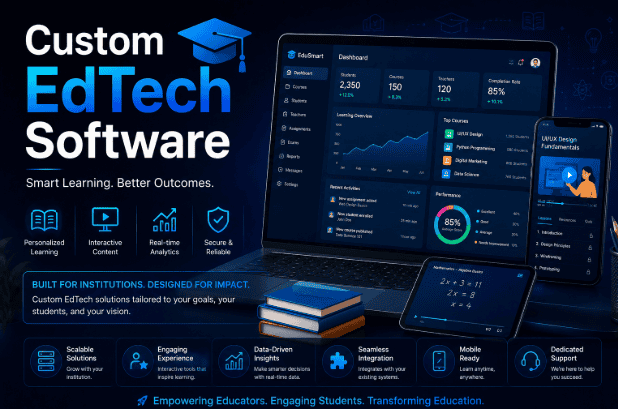
Education has moved far beyond textbooks and traditional classrooms, and digital learning has grown rapidly over the past few years. Schools, universities, and training departments now want tools that match their exact teaching style and internal workflow. This is where custom edtech software becomes valuable, since it offers a tailored alternative to generic platforms that often force institutions to adjust their own processes just to fit someone else’s product.
Unlike ready-made learning tools with fixed features and rigid structures, custom edtech software is built from the ground up to solve the specific problems faced by one institution or business. This guide explains what custom edtech software actually means, how it compares with off-the-shelf solutions, the features that make it effective, and the trends shaping its future.
What Is Custom EdTech Software?
Custom edtech software refers to digital learning tools or platforms built specifically for a school, college, training center, or business rather than purchased as a one-size-fits-all product. It is developed around the actual curriculum and technical requirements of the organization using it, so the system fits naturally into existing workflows instead of forcing staff and students to change their habits.
This kind of software can range from a complete learning management system to a smaller tool focused on one task, such as attendance tracking. The defining quality of custom edtech software is that every feature is intentionally designed for the people who will actually use it, rather than being a generic template applied across thousands of unrelated organizations.
Custom vs. Off-the-Shelf EdTech Solutions
When institutions modernize their learning systems, they usually choose between an existing platform like Moodle or Google Classroom, or investing in custom edtech software built around their own needs.
Off-the-shelf tools are quicker and cheaper to set up at first, but they limit branding, feature flexibility, and integration with existing systems. Custom development takes more time upfront, but it removes these restrictions and lets the platform grow alongside the organization.
The table below highlights the core differences between these two approaches.
| Factor | Off-the-Shelf EdTech Software | Custom EdTech Software |
| Initial Cost | Lower upfront cost with subscription fees | Higher upfront investment, no recurring license fees |
| Flexibility | Limited to existing features and templates | Built around exact institutional needs and workflows |
| Branding | Often restricted or generic | Fully branded to match institutional identity |
| Scalability | May require switching platforms as needs grow | Designed to scale with the organization over time |
| Integration | Limited to supported third-party tools | Can connect with any internal or external system |
| Long-Term Cost | Subscription fees add up across several years | Often more economical once the platform matures |
The right choice really depends on the institution’s size, budget, and how unique its requirements are. A small tutoring center with simple needs might do fine with an existing tool, while a growing university usually benefits more from custom edtech software built around its exact goals.
Types of Custom EdTech Software Solutions
Custom edtech software is not limited to one type of product, and institutions often need several connected systems working together. The list below covers common categories organizations choose when investing in custom solutions.
- Learning management systems host courses and track student progress in a structure that matches the institution’s own grading and curriculum policies.
- Student information systems handle enrollment, attendance, and grades, replacing scattered spreadsheets with one organized digital system.
- Virtual classroom tools allow live teaching with video and interactive whiteboards designed around the institution’s actual class sizes.
- Assessment platforms support secure online testing and automated grading configured to match the institution’s own academic integrity rules.
- Content authoring tools let teachers build interactive lessons and quizzes without depending on separate external software.
- Adaptive learning systems use performance data to personalize lesson pace, helping each learner progress at their own ability level.
Key Features of Effective Custom EdTech Software
A well-built custom edtech software solution should do more than digitize paper-based processes; it should genuinely improve how teachers, students, and administrators interact with the system. Role-based access lets administrators, teachers, students, and parents each see a version of the platform suited to their own permissions, while strong content management tools keep lessons organized in a way that mirrors how the institution actually teaches.
Real-time messaging and notifications keep everyone informed without relying on external apps that are easy to overlook. Assessment and feedback tools let teachers grade work and track progress within the same platform, and mobile responsiveness matters since many students prefer checking assignments from their phones. The ability to integrate with payment gateways or video tools is what lets custom edtech software act as a central hub rather than another isolated application.
Benefits of Investing in Custom EdTech Software
Investing in custom edtech software brings advantages that become more noticeable as an institution grows. Because the platform is designed around the organization’s own curriculum, staff typically adapt faster and face fewer frustrations than they would with a generic tool.
This tailored fit also improves student engagement, since the experience feels aligned with how the institution actually teaches rather than following an unrelated template.
Security and compliance control is another major benefit, since custom-built systems can be designed from the start around the data protection rules relevant to the institution’s location.
Many institutions also find custom edtech software more cost-effective than paying for multiple subscriptions year after year once it has scaled to support many users. For edtech businesses, a custom product creates a real competitive advantage that generic tools cannot replicate.
The Development Process Behind Custom EdTech Software
Building custom edtech software typically starts with a discovery phase, where the development team works closely with the institution to understand its curriculum and pain points with current tools.
Once requirements are clear, the team moves into UI and UX design, creating prototypes that reflect how teachers and students will actually navigate the platform. Development then follows in short agile sprints so features can be reviewed and adjusted along the way.
After development, thorough testing identifies bugs and usability issues before the software reaches real users. Deployment often includes data migration and staff training, with a transition period where old and new systems may run side by side. Ongoing maintenance and updates remain important after launch, since student needs and teaching methods naturally continue to evolve.
Compliance, Security, and Cost Considerations
Because custom edtech software often handles sensitive student data, compliance with regulations such as FERPA, GDPR, and COPPA must be considered from the very beginning of development.
This includes secure authentication, encrypted data storage, and accessibility standards like WCAG so students with disabilities can use the platform without barriers. Institutions operating across multiple countries also need to account for differing privacy laws affecting where data is stored.
Cost depends heavily on the complexity of features required, the size of the development team, and the level of design work involved.
While custom edtech software usually needs a larger upfront investment than subscribing to an existing platform, the absence of recurring license fees often makes it more economical over several years of continued use.
Future Trends Shaping Custom EdTech Software
The future of custom edtech software is being shaped by technologies that are already changing digital learning today. Artificial intelligence is increasingly used to personalize learning paths, recommending lessons based on a student’s past performance rather than offering identical content to everyone. Immersive technologies like augmented and virtual reality are also appearing in custom-built platforms, especially for subjects that benefit from hands-on simulation.
Mobile-first design and short microlearning formats are becoming standard rather than optional, since students increasingly prefer completing lessons on their phones. Predictive analytics is another growing trend, helping institutions identify students who may be falling behind early enough to offer support. As these technologies mature, custom edtech software will keep moving toward more personalized, data-driven learning experiences.
Frequently Asked Questions
How long does it usually take to build custom edtech software?
Timelines vary depending on complexity, but most custom edtech software projects take roughly three to nine months from planning through launch. Larger systems with several integrated modules can take longer due to extra testing and coordination.
Is custom edtech software more expensive than ready-made platforms?
The upfront cost is generally higher since you are paying for original design and development rather than shared infrastructure. However, many institutions find it more cost-effective after a few years, since there are no ongoing license fees to pay.
Can custom edtech software connect with systems we already use?
Yes, one of the biggest advantages is that it can be built to connect with tools you already rely on, such as payment gateways or video platforms. This integration is usually far more flexible than what off-the-shelf platforms allow.
Do smaller institutions really need custom edtech software?
Smaller institutions with simple, standard requirements may be served well enough by existing platforms without needing a custom build right away. That said, organizations with unique teaching models or plans for rapid growth often still benefit from a custom-built system.
What kind of support is needed after the software launches?
Most custom edtech software needs ongoing maintenance to fix bugs and add features as the institution’s needs change over time. Institutions usually maintain an in-house team or continue working with their original development partner for long-term support.
Conclusion
Custom edtech software offers a meaningful alternative for institutions that have outgrown generic learning platforms or simply need something built around their own teaching style.
While the upfront investment is larger than picking an existing tool, the long-term flexibility and scalability often make it the more practical choice for organizations planning steady growth.
Working with an experienced development partner who understands both technology and pedagogy will make a real difference in how the final platform turns out.
Related Articles
New Software Oxzep7 Python: Features, Benefits, Applications, and Complete Guide
Lab QMS Software: Complete Guide to Features, Benefits, and Implementation
Wolf 3D Software: Complete Guide to the Classic 3D Game Engine
Betechit.com Software Explained: Full Detailed Guide, Features, Uses, Benefits and Reality
What Is the Easiest 3D Modeling Software for Beginners in 2026?


