
Coding 2.0: The Future of AI-Powered Software Development
July 2, 2026
Secure Video Conferencing Software for Legal Firms
July 3, 2026
AEC software news today is driven by AI integration, BIM advancements, and major industry acquisitions reshaping the construction ecosystem. These developments help architects and engineers work more efficiently with automation and collaboration tools. BIM platforms now offer better visualization and real-time data sharing. This improves coordination and reduces project errors across teams. In the next section, we will explore these trends in more detail.
What is AEC Software News Today? (Real-Time Industry Updates Explained)
AEC software news today refers to real-time updates, technological advancements, and market shifts within the Architecture, Engineering, and Construction industries. In the points below, we will explain it in detail.
AI Integration in AEC Software
AI integration is one of the biggest drivers in AEC software news today, as companies are adopting intelligent tools to improve design accuracy and automate workflows. Modern AEC platforms use AI for predictive modeling, error detection, and faster project planning, reducing manual effort. These advancements also help teams make smarter decisions by analyzing construction data in real time.
BIM Technology Advancements
Building Information Modeling (BIM) continues to evolve as a key topic in AEC software news today. New BIM updates improve 3D visualization, collaboration, and real-time data sharing across teams. These enhancements help reduce design errors and improve coordination in modern construction workflows.
Market Acquisitions and Mergers
Another major highlight in AEC software news today is the rise of mergers and acquisitions among leading software companies. Large tech firms are acquiring smaller providers to expand capabilities and strengthen market position. This consolidation is creating more powerful, all-in-one platforms for design, engineering, and project management.
Cloud and Real-Time Collaboration Tools
Cloud-based AEC software solutions are gaining popularity due to better remote collaboration and real-time data access. These tools allow multiple stakeholders to work simultaneously, improving communication and reducing delays. Enhanced security and faster processing make them more reliable for large-scale construction projects.
Major AEC Software Releases and Announcements
Major AEC software releases and announcements focus on streamlining workflows, improving data confidence, and connecting different platforms. In the points below, we will explain it in detail.
Cloud-Based Platform Upgrades
Cloud-based upgrades in AEC software releases are designed to improve accessibility and allow teams to work from anywhere in real time. These updates help architects, engineers, and contractors share project data instantly without delays or version conflicts. Enhanced cloud infrastructure also improves data security and system performance across large-scale projects. In the next section, we will explore how these upgrades are improving collaboration across the AEC industry.
AI-Powered Feature Enhancements
AI-powered enhancements are a major part of new AEC software announcements, focusing on automating repetitive tasks and improving design accuracy. These features include predictive analytics, error detection, and smart design suggestions that reduce manual workload. AI tools are also helping teams make faster and more reliable project decisions. Next, we will discuss how these AI features are transforming modern construction workflows.
BIM Integration Improvements
Recent software releases are heavily focused on improving BIM integration to ensure better coordination between different project stakeholders. These updates allow real-time model sharing, clash detection, and improved visualization of complex structures. As a result, project teams can reduce errors and increase efficiency during the design and construction phases. Further explanation will show how BIM improvements are shaping industry standards.
Cross-Platform Connectivity Updates
Cross-platform connectivity is becoming a key highlight in AEC software announcements, enabling different tools and systems to work together seamlessly. These updates reduce data silos and improve communication between design, engineering, and construction teams. Improved API integrations also allow smoother data exchange between multiple software solutions. In the next section, we will look at how connectivity is driving the future of AEC technology.
AEC AI Software News and Automation Trends
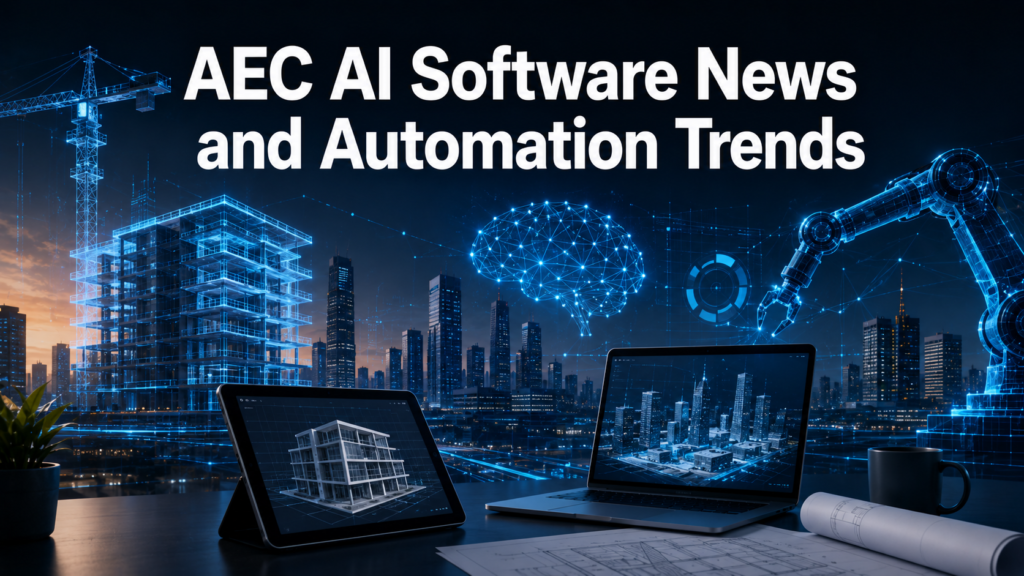
AEC AI software news and automation trends focus on generative design, vibe coding for custom automation, and agentic workflows that streamline complex AEC processes. In the points below, we will explain it in detail.
Generative Design in AEC Software
Generative design is becoming a core trend in AEC AI software news, allowing systems to automatically create optimized design options based on specific project requirements. These AI-driven tools analyze constraints like cost, materials, and space to produce efficient design alternatives. This reduces manual design effort while improving creativity and performance outcomes, enabling faster and more accurate project planning and better overall design efficiency.
Vibe Coding for Custom Automation
Vibe coding is emerging as a flexible approach in AEC software automation, enabling professionals to build custom workflows using AI-assisted coding techniques. It allows users to quickly adapt software behavior without deep programming knowledge, making automation more accessible. This trend is helping firms streamline repetitive tasks and improve project efficiency. Next, we will discuss how agentic workflows are transforming project execution.
Agentic Workflows in Construction Management
Agentic workflows are AI-driven systems that can independently manage and coordinate tasks across different stages of AEC projects. These workflows automate processes such as permitting, scheduling, and invoice reconciliation with minimal human intervention. As a result, teams can focus more on strategic decision-making while improving efficiency and reducing manual administrative work.
AI-Powered Jobsite Monitoring Systems
AI-powered jobsite monitoring is transforming how construction sites are managed by providing real-time tracking, safety analysis, and progress reporting. These systems use sensors, drones, and computer vision to detect issues and ensure compliance with project standards. This leads to improved safety, reduced delays, and better project transparency. In the next section, we will look at how these innovations are shaping the future of AEC automation.
Emerging AEC Software Startups and Innovations
Emerging AEC software startups and innovations are focused on connecting fragmented workflows, optimizing energy use, and managing complex regulatory compliance. In the points below, we will explain it in detail.
Workflow Integration Platforms
New AEC startups are building advanced workflow integration platforms that connect disconnected tools used across design, engineering, and construction teams. These platforms help eliminate data silos and improve real-time collaboration between stakeholders. By unifying different systems, they reduce project delays and improve overall efficiency. In the next section, we will explore how startups are optimizing energy usage in AEC projects.
Energy Optimization Technologies
Energy optimization is a major innovation area for AEC startups, focusing on creating sustainable and cost-efficient building designs. These tools use AI and simulation models to analyze energy consumption patterns and suggest improvements. This helps reduce environmental impact while lowering long-term operational costs. Next, we will discuss how startups are improving regulatory compliance management.
Regulatory Compliance Automation
AEC startups are increasingly developing solutions that automate complex regulatory compliance processes in construction projects. These systems help ensure that designs and builds meet local building codes and legal requirements. Automation reduces human error and speeds up approval processes for large-scale projects. In the next section, we will look at how compliance tools are evolving with Artificial_intelligence integration.
AI-Driven Construction Innovation Tools
AI-driven innovation tools are transforming how AEC startups approach project planning, design, and execution. These tools combine machine learning and predictive analytics to improve accuracy and reduce risks in construction workflows. They also help teams make faster decisions by analyzing large volumes of project data. Further discussion will explain how these innovations are shaping the future of the AEC industry.
Comparison Table – Top AEC Software in the News (2026)
This comparison table highlights the key differences between leading AEC software tools, helping readers quickly understand their purpose, latest updates, and real-world use cases.
| Software | Category | Latest Update Type | Key Impact | Industry Focus |
| Autodesk Revit | BIM | AI + cloud integration | Faster design workflows | Architecture & Engineering |
| AutoCAD | CAD | Automation upgrades | Precision drafting improvements | Design & Manufacturing |
| Procore | Construction Management | AI project insights | Better cost & schedule control | Construction firms |
| Bentley Systems | Infrastructure | Digital twin expansion | Smart infrastructure modeling | Civil engineering |
| Trimble | Field & Surveying | IoT + analytics updates | Real-time site tracking | Construction & Surveying |
How AEC Software News Impacts Real-World Projects
Keeping up with AEC software news directly improves project efficiency, reduces costs, and speeds up construction timelines. In the points below, we will explain it in detail.
- Faster Project Delivery
Staying updated with new AEC technologies helps firms adopt AI-driven estimation and automation tools quickly. This leads to faster planning, reduced delays, and more accurate scheduling across all project phases. - Reduced Material Waste
Modern AEC software innovations help optimize material usage through better design simulations and predictive analytics. This reduces unnecessary waste and can significantly lower construction expenses. - Improved Cost Efficiency
Companies that follow AEC software trends can implement smarter budgeting tools and automated cost tracking systems. This improves financial control and reduces unexpected project overruns. - Better Collaboration and Coordination
Updated AEC platforms improve communication between architects, engineers, and contractors through real-time data sharing. This ensures everyone works on the same updated information, reducing errors and rework. - Enhanced Decision-Making
Access to the latest AEC software news allows firms to use AI-powered insights for more informed decisions. This improves risk management and increases the overall success rate of construction projects.
Challenges in Keeping Up with AEC Software News
Keeping up with AEC software news is challenging due to rapid innovation cycles, high integration costs, industry fragmentation, and reliance on legacy BIM tools. In the points below, we will explain it in detail.
Rapid Innovation Cycles
One of the biggest challenges in AEC software news is the extremely fast pace of innovation across tools and platforms. Frequent updates and new AI features make it difficult for firms to stay consistently updated. This rapid change forces teams to continuously adapt workflows and retrain staff to keep up with evolving technology.
High Integration Costs
Integrating new AEC software solutions often involves high financial and technical costs for companies. Firms must invest in infrastructure upgrades, training, and compatibility adjustments before full implementation. These expenses can slow adoption, especially for smaller organizations, and limit faster digital transformation.
Industry Fragmentation
The AEC industry is highly fragmented, with multiple tools and platforms that often do not work seamlessly together. This lack of standardization makes it difficult to maintain a unified workflow across different project stakeholders. As a result, teams often struggle with data silos and communication gaps. In the next section, we will examine the impact of relying on legacy BIM systems.
Dependence on Legacy BIM Tools
Many organizations still rely heavily on legacy BIM systems that are not fully compatible with newer technologies. This slows down digital transformation and limits the adoption of advanced AI tools. It also creates challenges in upgrading workflows without disrupting ongoing projects and reduces long-term innovation in the AEC industry.
Future of AEC Software News and Industry Evolution
The future of AEC software news and industry evolution is moving toward fully connected, data-driven, and intelligent workflows across the construction ecosystem. In the points below, we will explain it in detail.
Fully Connected Digital Ecosystems
The future of AEC software is centered on building fully connected digital ecosystems where all tools and platforms communicate seamlessly. This will eliminate data silos and allow real-time collaboration between architects, engineers, and contractors. Integrated systems will improve project transparency and reduce delays caused by miscommunication. In the next section, we will explore how data-driven decision-making will shape future projects.
Data-Driven Decision Making
AEC industry evolution is increasingly focused on using data-driven insights to improve planning and execution. Advanced analytics tools will help teams predict risks, optimize resources, and improve project outcomes. This shift will make construction processes more efficient and less dependent on manual decision-making. Next, we will discuss how AI automation will further transform the industry.
AI and Automation Expansion
Artificial intelligence and automation will play a major role in the future of AEC software news by handling tasks like design optimization and scheduling. These technologies reduce human workload while improving accuracy and productivity. AI systems also enable faster issue detection and smarter decision-making across the AEC industry.
Smart Infrastructure and Digital Twins
Smart infrastructure and digital twin technology are expected to become standard in future AEC projects. These systems create virtual replicas of physical structures for real-time monitoring and performance analysis. This allows teams to improve maintenance, safety, and long-term efficiency of buildings. Further developments will continue to push the AEC industry toward a fully digital future.
FAQs
How can small construction firms afford to keep up with rapidly changing AEC software updates?
Small firms can start by adopting cloud-based subscription models that offer affordable access to regularly updated AEC tools without large upfront investments. Prioritizing essential features like BIM and project management over advanced AI tools helps manage costs effectively.
Are there any free or open-source AEC software options available for startups and independent architects?
The article does not mention any free or open-source AEC software alternatives for budget-conscious users. Independent architects and startups should research platforms like FreeCAD or Blender as possible low-cost starting points before investing in premium solutions.
How does AEC software handle data privacy and security for sensitive construction project information?
The article focuses on collaboration and AI features but does not specifically address data privacy policies or security certifications for AEC platforms. Organizations handling sensitive project data should verify that their chosen software complies with relevant data protection
conclusion
AEC software news highlights how AI, BIM advancements, and automation are transforming the architecture, engineering, and construction industry. These innovations are improving efficiency, accuracy, and collaboration across all project stages.
Despite challenges like high costs and legacy systems, the industry is steadily moving toward digital transformation. Overall, the future of AEC software is focused on smarter, faster, and more connected workflows.
Related Articles
Coding 2.0: The Future of AI-Powered Software Development
Moxhit4.6.1 Software System: Features, Benefits, Working Process, and Applications
Software HCS 411GITS Updated
Information About Foxtpax Software: Complete Guide, Features, Benefits & Use Cases
Neptune Navigation Software: Complete Guide to Features, Passage Planning & Marine Navigation (2026)


