
Moxhit4.6.1 Software System: Features, Benefits, Working Process, and Applications
July 2, 2026
AEC Software News Today: Latest Updates, AI Trends, Releases & Industry Insights
July 3, 2026
Software development is changing faster than ever before. For decades, programmers manually wrote every line of code, tested applications, fixed bugs, and maintained software systems. Today, artificial intelligence is transforming the development process and creating a new approach known as coding 2.0. This modern development style combines human creativity with AI-powered tools to make software creation faster, smarter, and more efficient.
The rise of AI coding assistants, intelligent development environments, and automated programming solutions has changed how developers build applications. Instead of spending hours writing repetitive code, programmers can now focus on solving business problems while AI handles many routine tasks. As a result, coding 2.0 is becoming an important topic for businesses, developers, students, and technology enthusiasts worldwide.
Introduction to Coding 2.0
The software industry has always evolved through innovation. From low-level programming languages to modern frameworks, every advancement has improved developer productivity. Coding 2.0 represents the next major step in this evolution.
Unlike traditional programming methods, coding 2.0 allows developers to communicate with AI systems using natural language instructions. Developers can describe what they want to build, and AI tools generate much of the required code. This shift is changing how software is designed, developed, tested, and maintained.
What Is Coding 2.0?
Coding 2.0 refers to an AI-assisted approach to software development where developers collaborate with intelligent systems to create applications more efficiently. Rather than manually writing every function and algorithm, programmers work alongside AI tools that can generate, optimize, and review code.
The goal of coding 2.0 is not to eliminate programmers but to increase their productivity. Developers remain responsible for architecture, decision-making, security, and business logic, while AI handles repetitive and time-consuming coding tasks.
Definition of Coding 2.0
Coding 2.0 can be defined as a software development methodology that combines human expertise with artificial intelligence to automate portions of the programming process while improving speed and efficiency.
This approach enables developers to transform ideas into working software much faster than traditional coding methods.
How Coding 2.0 Differs from Traditional Coding
Traditional coding requires developers to manually write, debug, and optimize every component of an application. The entire responsibility for implementation rests on the programmer.
In coding 2.0, AI tools assist with code generation, debugging, documentation, and testing. Developers focus more on defining objectives and reviewing results rather than creating every line manually.
Why Coding 2.0 Is Gaining Popularity
Businesses constantly seek faster development cycles and reduced costs. Coding 2.0 helps organizations release products more quickly while maintaining software quality.
At the same time, AI-powered tools are becoming increasingly accurate and accessible, making them attractive to both beginners and experienced developers.
The Evolution of Software Development
Understanding coding 2.0 becomes easier when examining how software development has evolved over time.
Coding 1.0: Manual Programming Era
The earliest stages of software development required programmers to write detailed instructions manually. Every feature, calculation, and user interaction had to be coded from scratch.
This approach provided maximum control but demanded significant time, effort, and technical expertise.
The Rise of Development Frameworks
Development frameworks simplified software creation by providing reusable components and predefined structures. Developers no longer needed to reinvent common features for every project.
Frameworks increased productivity and laid the foundation for modern software engineering practices.
The Emergence of AI-Assisted Development
Artificial intelligence introduced a new level of automation. AI systems learned from massive code repositories and began helping developers write software more efficiently.
These tools quickly evolved from simple autocomplete systems into intelligent coding assistants capable of generating complex solutions.
Transition from Coding 1.0 to Coding 2.0
The transition to coding 2.0 represents a shift from manual implementation to collaborative development with AI. Developers are no longer isolated creators but managers of intelligent development systems.
This transformation allows teams to focus on innovation rather than repetitive coding activities.
Core Principles of Coding 2.0
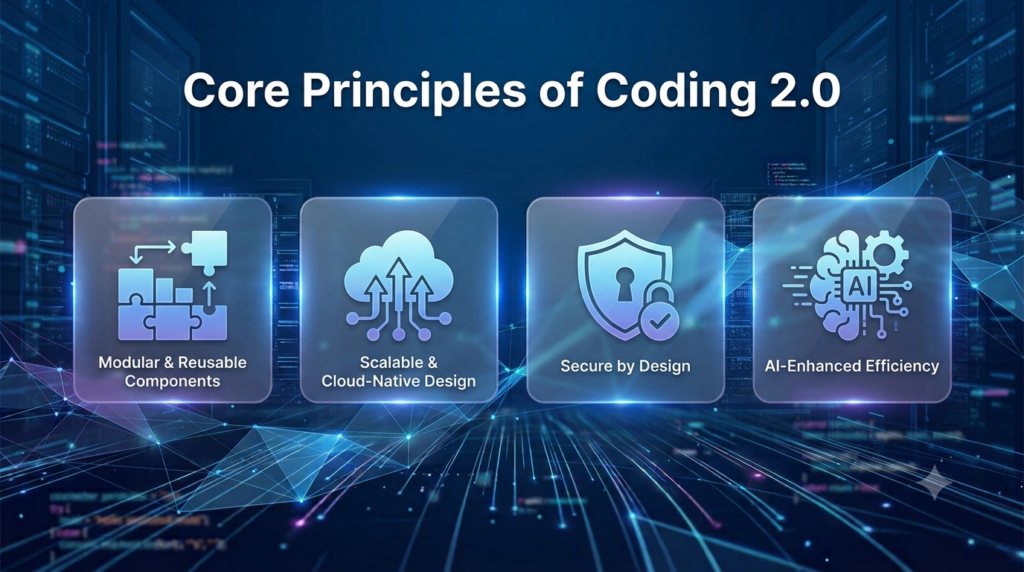
Several key principles define the coding 2.0 approach.
Human-AI Collaboration
The most important principle is collaboration. AI supports developers by providing suggestions, generating code, and identifying potential problems.
Human developers remain responsible for evaluating results and making final decisions.
Natural Language Programming
Coding 2.0 enables developers to communicate with AI using everyday language. Instead of writing extensive code manually, programmers can describe desired functionality through prompts.
This makes software development more accessible and efficient.
Prompt-Driven Development
Prompts serve as instructions for AI systems. The quality of these prompts significantly affects the generated output.
Developers increasingly need prompt engineering skills to maximize AI performance.
Automation and Productivity
Automation reduces repetitive work and allows developers to spend more time solving business challenges.
This increased efficiency helps organizations accelerate software delivery while maintaining quality standards.
How Coding 2.0 Works
Coding 2.0 follows a collaborative workflow between humans and AI systems.
Writing Requirements Instead of Code
Developers begin by describing application requirements. These descriptions may include desired features, workflows, user interactions, and business rules.
AI tools analyze these requirements and generate corresponding code structures.
AI Code Generation Process
The AI examines the provided instructions and produces code based on patterns learned from extensive training data.
Generated code often includes functions, classes, APIs, user interfaces, and database operations.
Testing and Validation
Although AI generates code, testing remains essential. Developers must verify functionality, security, and performance.
This validation process ensures that AI-generated solutions meet project requirements.
Continuous Improvement Through Feedback
Developers provide feedback to AI systems by refining prompts and correcting outputs.
Over time, this interaction improves both development efficiency and code quality.
Key Technologies Behind Coding 2.0
Several technologies power modern coding 2.0 solutions.
- Artificial Intelligence
- AI provides the intelligence needed to understand developer instructions and generate meaningful code.
- Advanced AI models can recognize patterns, solve problems, and assist with complex development tasks.
- Large Language Models (LLMs)
- Large language models are trained on vast amounts of programming and natural language data.
- These models enable AI systems to understand prompts and produce accurate coding solutions.
- Machine Learning
- Machine learning allows AI systems to improve their capabilities through training and data analysis.
- This technology helps coding assistants provide increasingly relevant suggestions.
- Generative AI Tools
- Generative AI creates new content, including source code, documentation, and testing scripts.
- These tools form the foundation of many coding 2.0 platforms.
- AI Coding Agents
- AI agents can perform multi-step tasks independently, such as creating modules, debugging applications, and managing workflows.
- Their capabilities continue expanding as AI technology advances.
Popular Coding 2.0 Tools and Platforms
Many organizations already use coding 2.0 tools in their development environments.
| Tool | Primary Purpose | Best For |
| GitHub Copilot | AI code assistance | Professional developers |
| ChatGPT | Code generation and explanations | Learning and development |
| Cursor AI | AI-powered coding environment | Advanced coding workflows |
| Replit AI | Cloud-based development | Beginners and startups |
| Amazon Q Developer | Enterprise development support | Business applications |
| Windsurf IDE | AI-native coding platform | Modern AI development |
Each platform offers unique capabilities, allowing developers to choose tools that best fit their workflows.
Traditional Coding vs Coding 2.0
The differences between traditional development and coding 2.0 are significant.
| Feature | Traditional Coding | Coding 2.0 |
| Code Creation | Manual | AI-assisted |
| Development Speed | Slower | Faster |
| Learning Curve | Higher | Lower |
| Productivity | Moderate | High |
| Automation | Limited | Extensive |
| Debugging | Manual | AI-supported |
These differences explain why many organizations are adopting coding 2.0 practices.
Benefits of Coding 2.0
Coding 2.0 offers numerous advantages for developers and businesses.
Faster Development Cycles
AI-generated code significantly reduces development time. Tasks that once required hours can often be completed within minutes.
This speed enables organizations to respond quickly to market demands.
Reduced Coding Complexity
Developers spend less time handling repetitive coding tasks and more time focusing on innovation.
This shift improves overall project efficiency and developer satisfaction.
Increased Productivity
By automating routine work, coding 2.0 allows teams to accomplish more within the same timeframe.
Higher productivity often translates into reduced development costs.
Better Accessibility for Beginners
New developers can learn programming concepts more easily with AI guidance.
Coding 2.0 lowers barriers to entry while supporting educational growth.
Enhanced Problem Solving
Developers can dedicate more attention to strategic challenges and creative solutions.
This improves software quality and business outcomes.
Challenges and Limitations of Coding 2.0
Despite its benefits, coding 2.0 is not without challenges.
Code Quality Concerns
AI-generated code may occasionally contain inefficiencies or unnecessary complexity.
Developers must carefully review all outputs before deployment.
Security Risks
Generated code may introduce vulnerabilities if not properly evaluated.
Security testing remains essential in every development process.
Dependency on AI Tools
Excessive reliance on AI can weaken fundamental programming skills.
Developers should maintain a strong understanding of software engineering principles.
Hallucinations and Errors
AI systems sometimes generate incorrect information or flawed code.
Human oversight remains critical for ensuring reliability.
Need for Human Oversight
Coding 2.0 works best when AI and human expertise complement one another.
Final responsibility for software quality always belongs to the development team.
Coding 2.0 for Beginners
Beginners can benefit significantly from coding 2.0 technologies.
Skills You Still Need to Learn
Understanding programming concepts, algorithms, and software architecture remains important.
AI assistance does not replace foundational technical knowledge.
Understanding Prompts
Effective communication with AI tools is becoming a valuable skill.
Well-written prompts produce more accurate and useful results.
Learning Software Fundamentals
Developers should continue studying databases, networking, security, and programming logic.
These skills help evaluate AI-generated solutions properly.
Building Your First AI-Assisted Project
Small projects provide an excellent opportunity to learn coding 2.0 workflows.
Practical experience helps beginners understand both AI capabilities and limitations.
Best Practices for Successful Coding 2.0
Successful adoption requires thoughtful implementation.
Write Clear Prompts
Specific and detailed instructions produce higher-quality outputs.
Developers should clearly define goals, requirements, and constraints.
Verify AI-Generated Code
Every generated solution should undergo thorough review and testing.
Verification prevents costly mistakes and security issues.
Maintain Coding Standards
Organizations should continue enforcing coding guidelines and best practices.
Consistency remains important regardless of how code is created.
Use Automated Testing
Automated tests help validate functionality and identify issues early.
Testing remains a critical component of modern software development.
Keep Security in Mind
Security should never be sacrificed for development speed.
Regular audits and reviews help protect software systems.
The Future of Coding 2.0
The future of coding 2.0 appears highly promising. AI systems are becoming more intelligent, capable, and autonomous with each generation.
Developers will increasingly manage AI-powered workflows rather than manually performing every programming task. Future development environments may include intelligent agents capable of designing, coding, testing, and deploying applications with minimal human intervention. However, human creativity, strategic thinking, and problem-solving skills will remain essential for building successful software products.
Is Coding 2.0 Replacing Software Developers?
Coding 2.0 is not replacing software developers. Instead, it is changing their responsibilities and expanding their capabilities.
Developers who learn to work effectively with AI tools will likely become more productive and valuable. Rather than eliminating jobs, coding 2.0 is creating a new generation of software professionals who combine technical expertise with AI-driven development practices.
Frequently Asked Questions (FAQs)
What does Coding 2.0 mean?
Coding 2.0 refers to an AI-assisted software development approach where developers collaborate with intelligent tools to create software faster and more efficiently.
Is Coding 2.0 the same as AI coding?
They are closely related concepts, but coding 2.0 focuses on the overall development methodology rather than just AI-generated code.
Can beginners use Coding 2.0?
Yes, beginners can use coding 2.0 tools to learn programming concepts and build projects while receiving AI assistance throughout the development process.
Conclusion
Coding 2.0 is transforming the software development industry by combining human creativity with artificial intelligence. Through AI-assisted coding, natural language programming, and automated workflows, developers can build software faster and more efficiently than ever before.
As technology continues to evolve, coding 2.0 will become an increasingly important skill for developers, businesses, and students. Those who embrace this new development model will be better positioned to succeed in the future of software engineering.
Related Articles
Betechit.com Software Explained: Full Detailed Guide, Features, Uses, Benefits and Reality
Custom EdTech Software: A Complete Guide to Smarter Learning Platforms
Why GenBoosterMark Software Is So Popular?
New Software Oxzep7 Python: Features, Benefits, Applications, and Complete Guide
GoPerfect AI Hiring Software: Complete Guide to Smarter Recruiting


